The Block Universe Theory
What if the past, present, and future all exist simultaneously — as equally real slices of a four-dimensional universe? This is the Block Universe, and it follows directly from Einstein's Special Relativity.

Imagine that the universe is not a film playing out frame by frame — a flickering present advancing through time — but more like a finished book: every page already written, every scene already there, waiting to be read. Past chapters don’t cease to exist when you turn the page. Future chapters don’t fail to exist because you haven’t reached them yet.
This is, roughly, the idea behind the Block Universe: a view of time according to which past, present, and future all exist equally and simultaneously, laid out together in the four-dimensional fabric of spacetime.
It sounds like philosophy. But it follows — with uncomfortable directness — from one of the most precisely tested theories in all of physics: Einstein’s Special Theory of Relativity.
How We Normally Think About Time
Before we can understand the Block Universe, we need to understand what it is reacting against.
Our instinctive view of time — the one built into everyday language and common sense — is something philosophers call Presentism: only the present moment exists. The past is gone; it used to exist but no longer does. The future doesn’t exist yet; it will exist when it arrives. The present is real; everything else is either memory or anticipation.
On this view, time is like a spotlight moving across a dark stage. The pool of light — the present — is real. Everything behind it has vanished. Everything in front of it hasn’t arrived yet. Time flows.
This feels obvious and natural. It’s deeply embedded in how we experience being alive. But it turns out to be in serious tension with the physics of Special Relativity.
What Special Relativity Does to “Now”
To understand the Block Universe, you first need to understand one of Special Relativity’s most disorienting predictions: the relativity of simultaneity.
In our article on What is Spacetime?, we explored how Einstein showed that space and time are not fixed, absolute quantities — they stretch and compress depending on how fast you’re moving. One of the consequences is that two observers moving at different velocities will disagree about whether two distant events happened at the same time.
Imagine a long train moving at high speed through a station. A lightning bolt strikes the front of the train and another strikes the back, simultaneously — as measured by an observer standing at the midpoint of the platform. Both flashes reach the platform observer at the same moment. She concludes: the strikes were simultaneous.
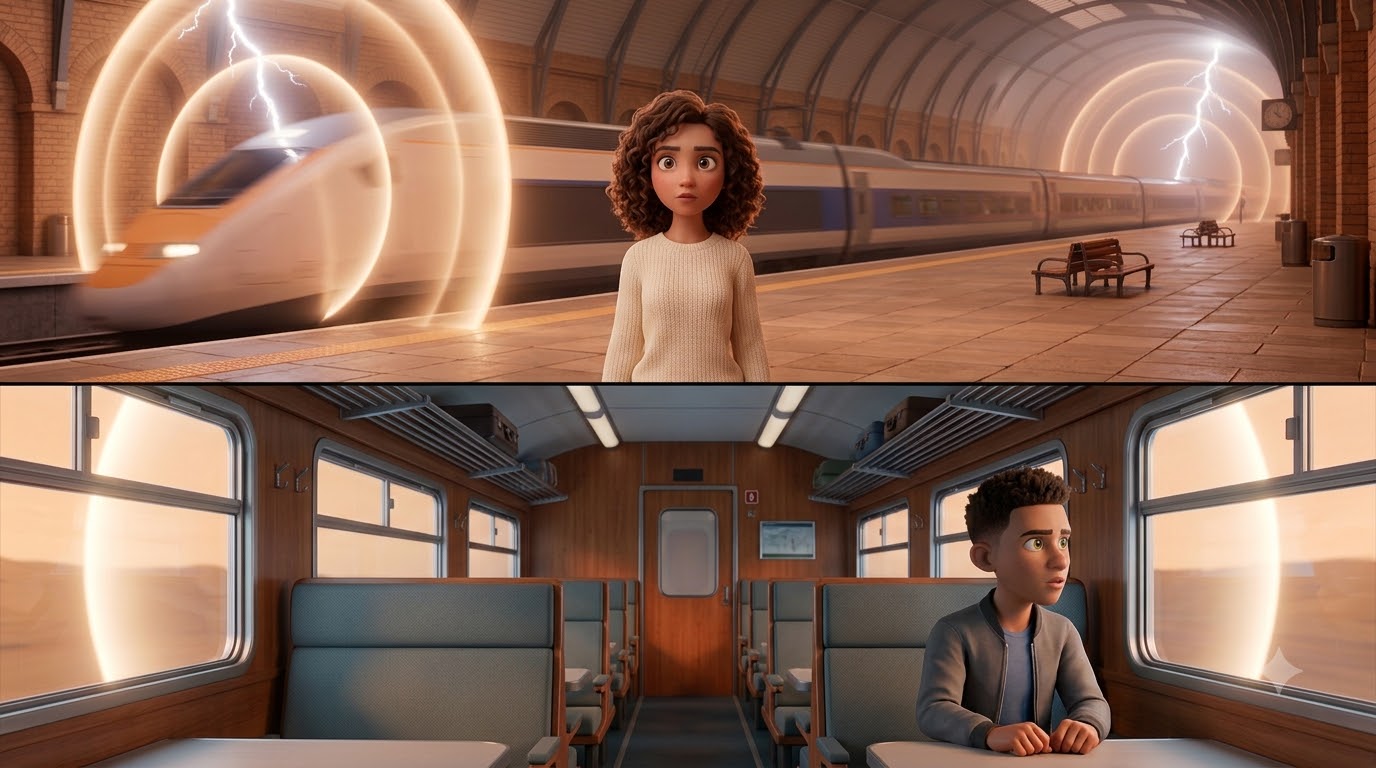
Now consider a passenger sitting at the exact midpoint of the train. The train is moving forward, so he is moving toward the light from the front strike and away from the light from the rear strike. The front flash reaches him first. He concludes: the front strike happened before the rear strike.
Both observers are equally correct. There is no “true” answer about which happened first. The notion of simultaneity — of two events happening “at the same time” — depends entirely on your state of motion.
✅ Established fact: The relativity of simultaneity is a direct, experimentally confirmed consequence of Special Relativity. It is not a quirk of perception or instrumentation — it follows mathematically from the constancy of the speed of light, which has been verified to extraordinary precision.
The Andromeda Paradox
Here is where this becomes philosophically explosive. This argument was developed by the physicist Roger Penrose, building on earlier work by C.W. Rietdijk and Hilary Putnam.
Imagine two people standing side by side on Earth. One is standing still. The other is walking slowly away from you — say, at a brisk walking pace. In terms of ordinary experience, their differences in speed are trivially small.
But the Andromeda Galaxy is approximately 2.5 million light-years away. At that distance, the relativity of simultaneity stretches tiny differences in velocity into enormous differences in “what’s happening now.”
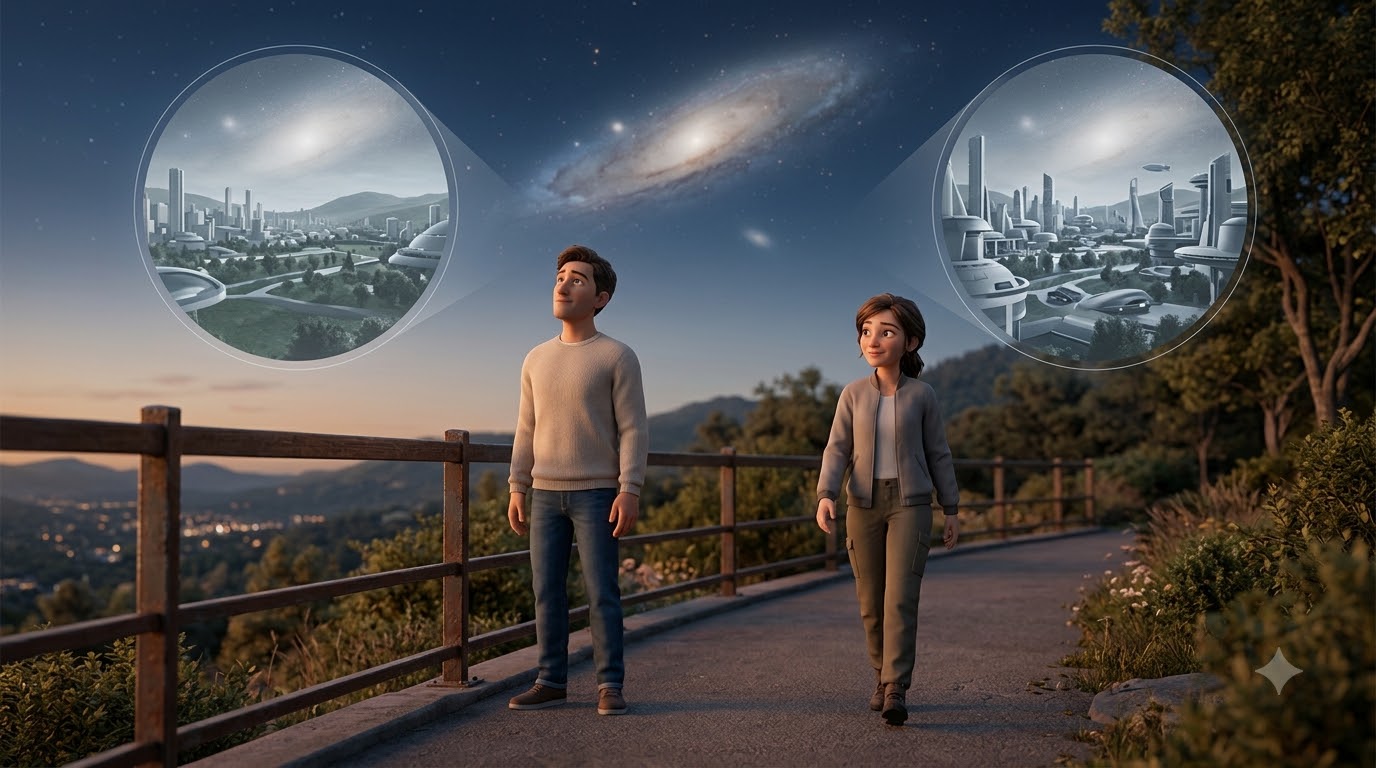
Because of their different velocities, the person walking away from you and the person standing still have slightly different definitions of “now” — and at 2.5 million light-years, those definitions diverge by years. The walking person’s “now” in the Andromeda Galaxy might include events that are, by the standing person’s reckoning, still in the future.
Both “nows” are equally valid in Special Relativity. If the future event is already included in one person’s present, then in what sense is it “not yet real”?
🔬 Not experimental claim: The Andromeda Paradox is a philosophical argument about what Special Relativity implies. The physics of Special Relativity is established. The conclusion — that the future is therefore “already real” — is a philosophical interpretation, not itself a testable prediction. It is, however, taken seriously as a logical consequence of the physics.
The Block Universe: All of Time Exists
The Block Universe (also known as Eternalism in philosophy) is the view that takes this argument seriously and follows it to its conclusion.
In a Block Universe:
- All moments in time exist equally. Your birth, your current reading of this article, and events a thousand years hence are all equally real, all present in the four-dimensional block of spacetime.
- There is no privileged “now.” The present moment is not metaphysically special. It is simply your current position in spacetime — like being at a particular location in space.
- Time does not “flow.” The apparent flow of time — the feeling that the present is moving forward — is something about how conscious observers experience their path through spacetime, not an objective feature of the universe.
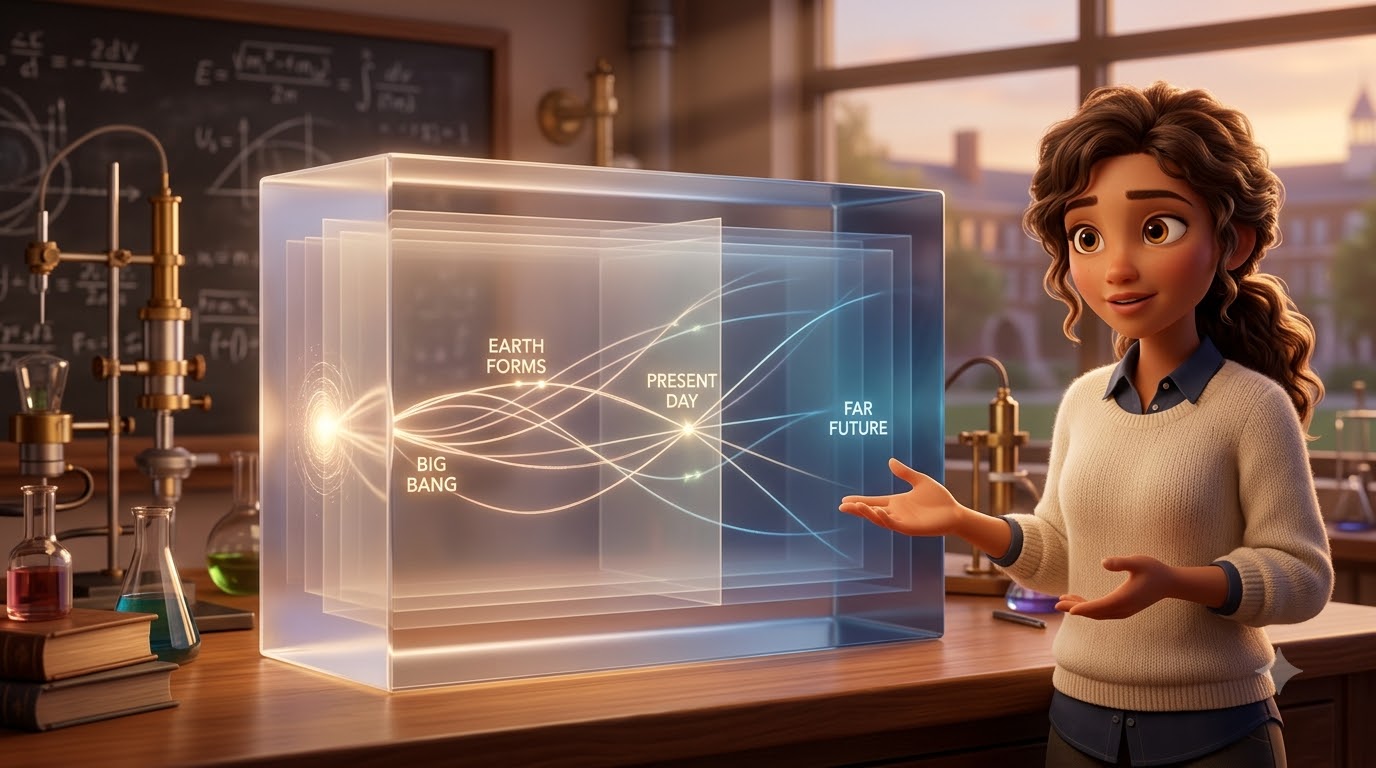
Think of spacetime as a vast, four-dimensional block of ice. Every event — from the Big Bang to the far future — is a point or region in this block. The block doesn’t change; it simply is. You, as a conscious observer, are a particular worldline threading through the block — a long, thin path through spacetime that represents your history. What you call “now” is just the point on that path where your experience currently is located.
💡 Worldline is the path an object traces through spacetime — the complete history of its position at every moment in time. In the Block Universe, every object has a fixed worldline that simply exists in the block.
The “Frozen River” Analogy
Think of a river. While you stand at the bank and watch, the water flows past. The water upstream “hasn’t arrived yet”; the water downstream “has already passed.” The flow of the river feels dynamic and real.
But now imagine photographing the entire river from high above — every bend, every eddy, the water from source to sea — all captured in a single image. From this aerial view, there is no flow. The river is simply a pattern in space. Water that is “upstream” and water that is “downstream” coexist in the image.
The Block Universe suggests that time is like this aerial photograph. What feels like flow from inside the river — from inside time — is, from the “outside” perspective of the whole of spacetime, simply a static pattern.
Of course, the analogy breaks down: you can’t actually stand “outside” spacetime and view it all at once. But the mathematical framework of Special Relativity does treat all events in a spacetime diagram equally, without privileging any particular moment as “now.”
Does This Mean the Future Is Fixed?
This is the question most people ask first — and it is easy to misunderstand.
The Block Universe is a claim about what exists (ontology), not about what is determined (determinism). In a block universe, all events exist — but the question of whether those events are strictly determined by prior causes is separate.
Even in a Block Universe, the laws of physics might include genuine randomness — as quantum mechanics suggests. The events that exist in the block might be partly random and unpredictable, even if they are all equally real once they exist.
What the Block Universe does imply is that your future, whatever it contains, already exists in spacetime — just as your past does. Whether it was determined or arrived at randomly is a further question. But it is already there, in the block.
⚠️ Important distinction: Accepting the Block Universe does not commit you to fatalism — the view that you cannot affect your future. Your choices and actions are events in spacetime too; they are part of the causal chain that produces future events. The block includes your choices, not just their outcomes.
The “Flow” of Time: An Enduring Puzzle
If all moments exist equally, where does the feeling of time flowing come from?
This is genuinely one of the hardest problems in the philosophy of physics, and it remains unsolved. Several approaches have been proposed:
1. The psychological arrow. Our feeling of time flowing may be a feature of consciousness and memory, not of spacetime itself. We have memories of past events but not future ones (because of the Arrow of Time, rooted in entropy — see our article The Arrow of Time). The direction of memory-building gives us the felt sense of moving forward.
2. The “moving spotlight” theory. Some philosophers propose that even in a block universe, there is an objective “now” that moves through the block — a kind of spotlight that makes one moment especially real at each instant. But this is widely seen as philosophically awkward: what determines where the spotlight is, and what moves it?
3. The flow is an illusion. The most direct reading of the Block Universe is that the apparent flow of time is a kind of cognitive illusion — not that it isn’t real as an experience, but that it doesn’t correspond to anything objective in physics. This is uncomfortable but may be the most consistent position.
🔬 Active philosophical debate: There is no consensus on the origin of the felt flow of time. This is one of the central open questions at the intersection of physics, philosophy, and neuroscience.
Challenges and Alternatives
The Block Universe is not the only interpretation of what Special Relativity implies about time, and it faces genuine challenges.
The Growing Block Universe. This view holds that the past and present are real, but the future does not yet exist. The block grows as new moments become present. While this keeps the future open, critics argue it reintroduces a privileged “now” that conflicts with Special Relativity.
The Presentist defense. Some philosophers maintain that only the present exists, attempting to salvage Presentism by defining a preferred slice of spacetime. However, this remains a minority view because it requires adding assumptions not present in standard relativity.
Quantum mechanics complications. A static block model aligns naturally with classical physics, but quantum indeterminacy and wave-function collapse pose challenges. While some frameworks (like Many-Worlds) fit a block view, reconciling a static spacetime with quantum physics remains an open question.
What Physicists Think
It’s worth being clear about where the consensus lies.
Special Relativity is an established fact. The relativity of simultaneity is among the most rigorously verified results in physics.
The Block Universe as a philosophical interpretation: This is where opinion divides. Many physicists are comfortable with the Block Universe as a natural reading of the formalism of Special Relativity. Others are agnostic, or argue that the question of what “really exists” lies beyond what physics alone can answer. Very few working physicists adopt a naive Presentism that ignores the relativity of simultaneity.
The physicist Hermann Minkowski — who first formalised spacetime geometry in 1908 — spoke of “the eternal now” implicit in his mathematics. Einstein himself was sympathetic to the Block Universe view; in a famous letter of condolence written in 1955 after the death of his lifelong friend Michele Besso, he wrote: “Now he has departed from this strange world a little ahead of me. That means nothing. For us believing physicists, the distinction between past, present, and future is only a stubbornly persistent illusion.”
⚠️ A note on Einstein’s letter: This quote is frequently cited but should be interpreted carefully. It expresses Einstein’s personal philosophical view, not a scientific claim with predictive content. It reflects his sympathy for a block-universe reading of relativity, but is not itself a scientific argument.
A Quick Summary
| Concept | What it means |
|---|---|
| Presentism | Only the present moment exists; past and future are not real |
| Block Universe (Eternalism) | Past, present, and future all exist equally in 4D spacetime |
| Relativity of simultaneity | Two observers in relative motion disagree on which events are simultaneous (established fact) |
| Worldline | An object’s complete history as a path through spacetime |
| Andromeda Paradox | Argument showing different observers’ “nows” diverge enormously at cosmic distances |
| Growing Block | A variant where only past and present exist; the future is not yet real |
| Flow of time | The felt sense of time passing; its origin in a block universe is an open philosophical problem |
Why This Matters
The Block Universe is not just an abstract puzzle for philosophers. It touches on some of the most profound questions we can ask:
- Is free will compatible with physics? If your future already exists in the block, what does it mean to make a choice?
- What is consciousness? If the flow of time is not an objective feature of the universe, where does the feeling of “now” come from?
- What is the relationship between time and causality? In a block universe, causality is a pattern within the block — causes and effects both exist, but causes come before effects along each worldline.
- What are we, in time? We are not points; we are worldlines — extended patterns through spacetime that have duration.
These questions sit at the boundary between physics and philosophy, and they don’t have settled answers. But they are not idle speculation. They follow from taking the mathematics of Special Relativity seriously as a description of reality.
Whether or not the block universe is the final word on the nature of time, engaging with it forces us to question assumptions so deep we barely notice we’re making them. It is one of the great intellectual adventures that modern physics opens up — a reminder that the equations of nature have implications that go far beyond the laboratory.
Further reading: For the philosophy, see The Philosophy of Time edited by Robin Le Poidevin and Murray MacBeath, or Time Reborn by Lee Smolin (which argues against the block universe). Carlo Rovelli’s The Order of Time is an accessible and beautifully written treatment.