The Arrow of Time
Why does time only move forward? Eggs break but never unbreak. Coffee cools but never spontaneously heats. Physicists call this the Arrow of Time — and its origins reveal something deep and surprising about the universe.

Drop an egg. Watch it shatter across the floor. Now imagine playing that video in reverse: a thousand fragments leap upward, fuse seamlessly into a perfect egg, and land gently in your palm.
You immediately know something is wrong. The reversed film is absurd. The universe simply doesn’t work that way. Time has a direction. Past is past. Future is future. The present is the fleeting, irreversible threshold between the two.
This seems so obvious that it barely needs saying. But here is what makes it one of the most profound puzzles in all of physics: the fundamental laws of nature do not have a preferred direction of time. If you filmed a collision between two billiard balls and played the footage backwards, both the forward and reverse versions would obey Newton’s laws perfectly. The same is true for electromagnetic waves, quantum mechanics, and Einstein’s gravity.
So where does the arrow come from?
Laws That Don’t Care About Direction
Let’s make the puzzle concrete.
At the microscopic level — atoms bouncing off each other, electrons absorbing and emitting light — the equations of physics look essentially the same whether time runs forward or backward.
Newton’s laws of motion are symmetric in time. Maxwell’s equations for electromagnetism are symmetric in time. Schrödinger’s equation in quantum mechanics is symmetric in time. General Relativity is symmetric in time. Play the film of two atoms colliding, then play it backwards: both are equally valid according to the laws of physics.
Yet at the macroscopic level — the everyday world of an egg shattering, or ice melting, or smoke billowing from a chimney — runs in one direction only. The two levels seem to contradict each other. Microscopic symmetry, macroscopic asymmetry.
The resolution to this contradiction is one of the great achievements of 19th- and 20th-century physics, and it is rooted in a single concept: entropy.
The Measure of Disorder
Entropy is a word that physicists use to measure something precise: the number of ways a system can be arranged internally while still looking the same from the outside.
Here’s a simple analogy. Imagine you have 100 coins in a box. You shake the box and open it. You could find all 100 heads facing up — but that’s only one specific arrangement. Alternatively, you could find about 50 heads and 50 tails — and there are billions of different ways to arrange 50 heads and 50 tails. The “all heads” outcome has very low entropy: there’s only one way to achieve it.

The “roughly half and half” outcome has very high entropy: there are enormously many arrangements that produce it. This is the key insight: high-entropy states are vastly more probable than low-entropy states, simply because there are so many more ways to be disordered than to be ordered.
Release a puff of perfume from a bottle in one corner of a room. The molecules start highly concentrated — low entropy. Over time, they drift and spread until they are evenly distributed throughout the air — high entropy. You have never seen perfume spontaneously re-concentrate itself back into the bottle, because that would require all the molecules to happen to move in precisely the right directions simultaneously. The odds are not zero — they are just staggeringly, incomprehensibly small.
💡 Entropy (from the Greek entropia, “transformation”) was first rigorously defined by the German physicist Rudolf Clausius in the 1860s and given its statistical interpretation by Ludwig Boltzmann in the 1870s–1890s.
The Second Law of Thermodynamics
The irreversibility of entropy has been formalised as one of the most fundamental laws in all of science:
The total entropy of a closed system never decreases over time. It either stays the same or increases.
“Closed system” means a system with no energy flowing in or out. In practice, the entropy of any isolated region of the universe tends to increase. Systems naturally move from ordered, low-entropy states to disordered, high-entropy states.
The Second Law is where the Arrow of Time enters physics. Because entropy always increases in one direction of time, it gives us a way to distinguish the past from the future: the past is the direction of lower entropy; the future is the direction of higher entropy.
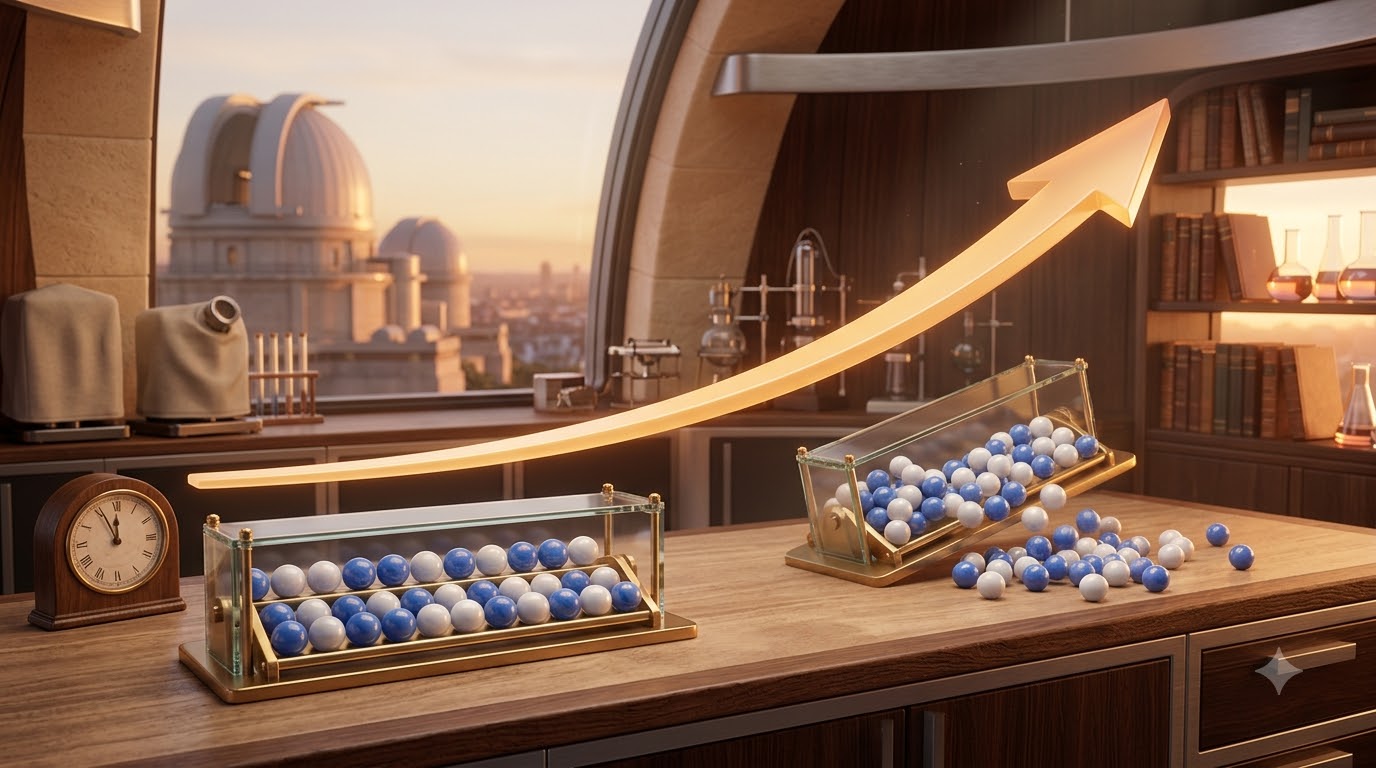
This is why:
- Eggs break but don’t reassemble. A whole egg is a highly organised, low-entropy object. A smashed egg is disordered: high entropy. The transition from low to high entropy is overwhelmingly probable. The reverse is overwhelmingly improbable.
- Heat flows from hot to cold, never the reverse. A hot cup in a cold room is a low-entropy configuration (energy concentrated in one place). The heat spreading through the room is higher entropy.
- We remember the past but not the future. Memory formation is a physical process that increases entropy — it creates a record, a low-entropy imprint of a past event. The Arrow of Time and the arrow of memory point in the same direction.
✅ Established fact: The Second Law of Thermodynamics is one of the most thoroughly verified principles in physics. It applies across classical mechanics, quantum mechanics, and statistical physics. No violation of this law has ever been observed.
The Thermodynamic Arrow in Everyday Life
It is worth pausing to appreciate how many apparently separate “arrows” in everyday life are really the same arrow — entropy increase — in different guises.
- Ageing: Biological organisms are extraordinarily complex, low-entropy structures. Metabolism requires a continuous intake of low-entropy energy (food, sunlight) to maintain that structure. Eventually, the fight against entropy is lost.
- Combustion: Fire takes ordered chemical bonds and releases them as disordered heat and gas — entropy increases dramatically.
- The mixing of substances: Drop ink into water. It spreads. Mixing is high-entropy; unmixing is fantastically improbable.
The thermodynamic arrow is not a separate phenomenon for each of these — it is the single underlying principle, playing out across countless systems.
But Why Did It Start Low?
Here is where the story deepens — and where we encounter one of the most profound open problems in physics. For the Second Law to explain the Arrow of Time, it is not enough to say that entropy tends to increase. We also have to explain why entropy was so low to begin with.
Think about it this way. If you woke up with no memory of the last hour, and you saw a half-drunk cup of tea in your hand, you would infer that some time ago the cup was full. You reason backwards: the past must have been more ordered than the present. But if entropy is always increasing in the direction of the future, then the further back you go, the lower the entropy must have been.
Follow this logic all the way back, and you reach the Big Bang: a state of the universe that must have been extraordinarily, almost incomprehensibly, low in entropy.

The early universe was not simply hot and dense — it was highly ordered. Energy and matter were distributed in a very specific, smooth, low-entropy configuration. From that special starting point, the universe has been unfolding in the direction of increasing entropy ever since — producing stars, galaxies, planets, life, and eventually the dispersal of all structure.
This is the crucial point: the Arrow of Time is not written into the laws of physics. It is a consequence of the extremely special initial conditions of the universe. If the universe had started in a generic, high-entropy state, there would be no arrow — entropy could not increase further in a meaningful sense, and the distinction between past and future would vanish.
The Past Hypothesis
Physicist and philosopher David Albert gave a name to the assumption underlying the above: the Past Hypothesis — the postulate that the universe began in an extremely low-entropy state.
The Past Hypothesis is not itself derived from any deeper physical principle. It is, at present, a boundary condition: a fact about the initial state of the universe that is assumed, not explained. Various approaches have been proposed to explain it, including ideas connected to quantum cosmology and the geometry of the early universe, but none has achieved consensus.
The physicist Roger Penrose has argued that the fine-tuning of the initial entropy of the universe is so extreme that it represents one of the most pressing unsolved problems in theoretical physics. He has proposed that a future theory — he calls it Conformal Cyclic Cosmology — might explain it in terms of a cyclic universe. But this remains speculative and has not been confirmed.
Other Arrows of Time
The thermodynamic arrow — entropy increasing — is the primary arrow. But physicists identify several other “arrows” that all point in the same direction, and may all share the same root cause.
The Cosmological Arrow
The universe is expanding. This expansion defines a direction: the direction in which the universe is growing is “the future.” The cosmological arrow and the thermodynamic arrow point in the same direction — and many physicists believe this is not a coincidence. The expansion of the universe is likely connected to why the initial universe was in such a low-entropy state.
The Radiation Arrow
When you switch on a lamp, light radiates outward from the bulb in all directions. The equations of electromagnetism actually admit two types of solutions: waves that spread outward from a source, and waves that converge inward from all directions toward a point. In nature, we only ever observe the outward-spreading kind. This selection defines another arrow, pointing in the same direction as the thermodynamic arrow.
The Psychological Arrow
You remember the past but not the future. Your sense of self is constructed from memories of events that have already happened, not events yet to come. This psychological arrow — the direction in which memory and causality run — is deeply connected to the thermodynamic arrow. Memory formation is a physical process that increases entropy. The direction in which memories accumulate is the direction of increasing entropy.
💡 All these arrows point in the same direction. Whether they share a single common cause — the low-entropy initial conditions of the Big Bang — is a major open question. Most physicists believe they do.
The Exception: CP Violation
Earlier, we said the laws of physics are time-symmetric. That is almost true. There is one known exception.
In the 1960s, physicists discovered that certain rare particle decays mediated by the weak nuclear force exhibit a subtle asymmetry. Particles and their antiparticle counterparts do not always behave in exactly mirror-image ways. By the CPT theorem — a deep result in quantum field theory — this implies a corresponding asymmetry in time reversal. This phenomenon is known as CP violation.
CP violation is real and experimentally confirmed. It is, however, extremely small and confined to very specific particle interactions. It cannot explain the macroscopic Arrow of Time — the reason eggs break rather than reassemble. It may, however, be related to why the early universe contained slightly more matter than antimatter — a question connected to our own existence, but separate from the everyday arrow of time.
What Happens at the End?
If entropy always increases, where does it end?
Physicists call the theoretical endpoint the heat death of the universe: a distant future state in which all energy has been evenly distributed, no more work can be done, and no more change can occur. Stars will have burned out, black holes will have evaporated (by a quantum process called Hawking radiation), and the universe will settle into a vast, cold, featureless equilibrium.
At this point, in a technical sense, time would still exist — but nothing would happen. There would be no arrow. No before and after. No distinction between past and future.
This fate is projected to be incomprehensibly far in the future — on timescales of 10^100 years and beyond. The observable universe is only about 13.8 billion years old. We are, in cosmic terms, extremely early in the story.
A Quick Summary
| Concept | What it means |
|---|---|
| Arrow of Time | Time’s observed direction: processes run from past to future, not in reverse |
| Entropy | A measure of disorder; the number of microscopic arrangements producing the same macroscopic state |
| Second Law of Thermodynamics | Entropy of a closed system always increases or stays the same — established fact |
| Thermodynamic Arrow | The direction of increasing entropy defines the direction of time |
| Past Hypothesis | The assumption that the early universe had extremely low entropy — observed, but unexplained |
| CP Violation | A tiny asymmetry in weak-force particle decays — real, but not responsible for the everyday Arrow |
| Heat Death | The far-future state of maximum entropy, when no further change is possible |
Why This Matters
The Arrow of Time underpins almost everything we consider fundamental about existence:
- Causality — the principle that causes precede effects — depends entirely on the Arrow of Time. Without it, the distinction between cause and effect would dissolve.
- Memory and identity — who you are, and what you know, is built from records of the past. The Arrow of Time is what makes the past recordable and the future open.
- Life itself — biological organisms are low-entropy structures that survive by consuming low-entropy energy and expelling high-entropy heat. We are, in a deep sense, creatures of the Arrow of Time.
- The beginning and end of the universe — understanding the Arrow means grappling with why the universe began as it did, and where it is ultimately heading.
The physicist Arthur Eddington, who coined the phrase “arrow of time” in 1927, wrote: “If as we follow the arrow we find more and more of the random element in the state of the world, then the arrow is pointing towards the future; if the random element decreases, the arrow points towards the past.”
That random element is entropy. And the fact that it starts low and grows — that the universe was born in a state of improbable order and has been running down ever since — is not just a curiosity. It is the reason eggs break, the reason you grow old, the reason you can remember yesterday but not tomorrow, and the reason the universe has a story to tell at all.
Further reading: For the philosophical depth, see Time’s Arrow and Archimedes’ Point by Huw Price. For an accessible treatment, Carlo Rovelli’s The Order of Time is highly recommended. Sean Carroll’s From Eternity to Here is the most comprehensive overview of the Arrow of Time and the Past Hypothesis.