What is Spacetime?
A beginner-friendly guide to one of physics' most profound ideas: how space and time are not separate stages for the universe, but a single, flexible fabric that shapes everything we experience.
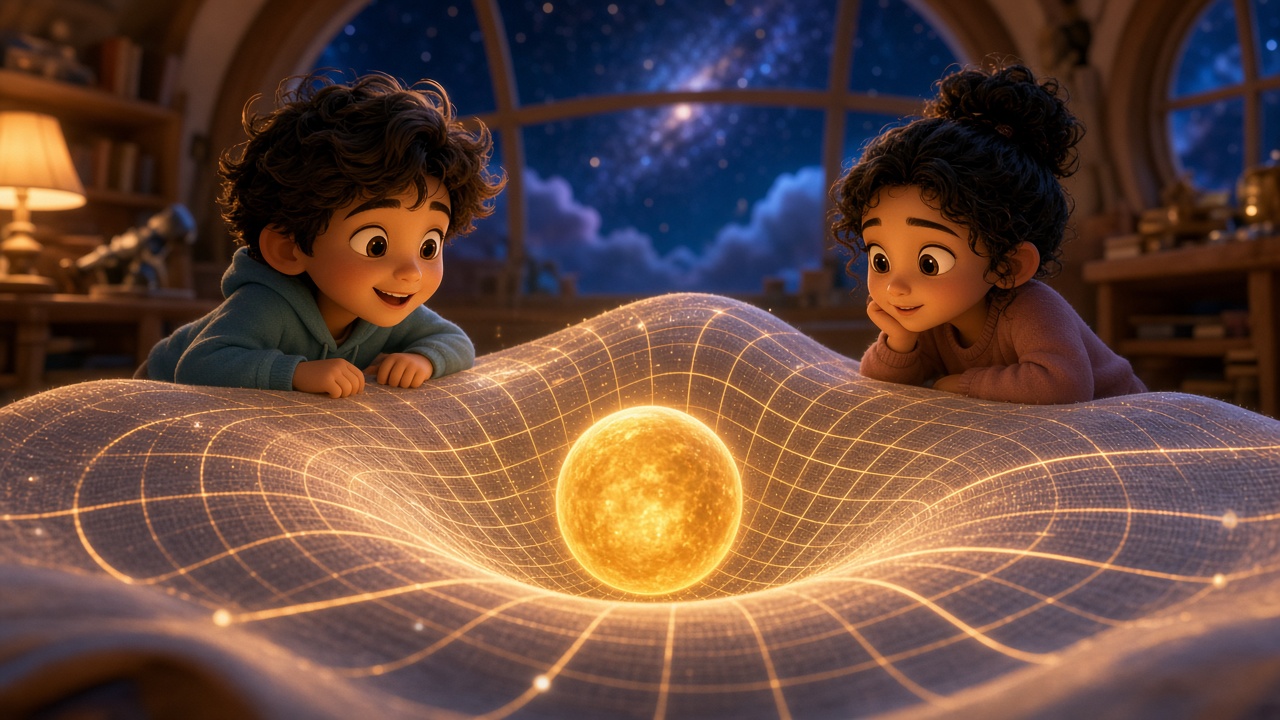
You probably think of space and time as completely separate things. Space is where you are — the room you’re sitting in, the city outside your window, the vast emptiness between stars. Time is when things happen — seconds ticking on a clock, the Sun rising and setting, your life unfolding moment by moment.
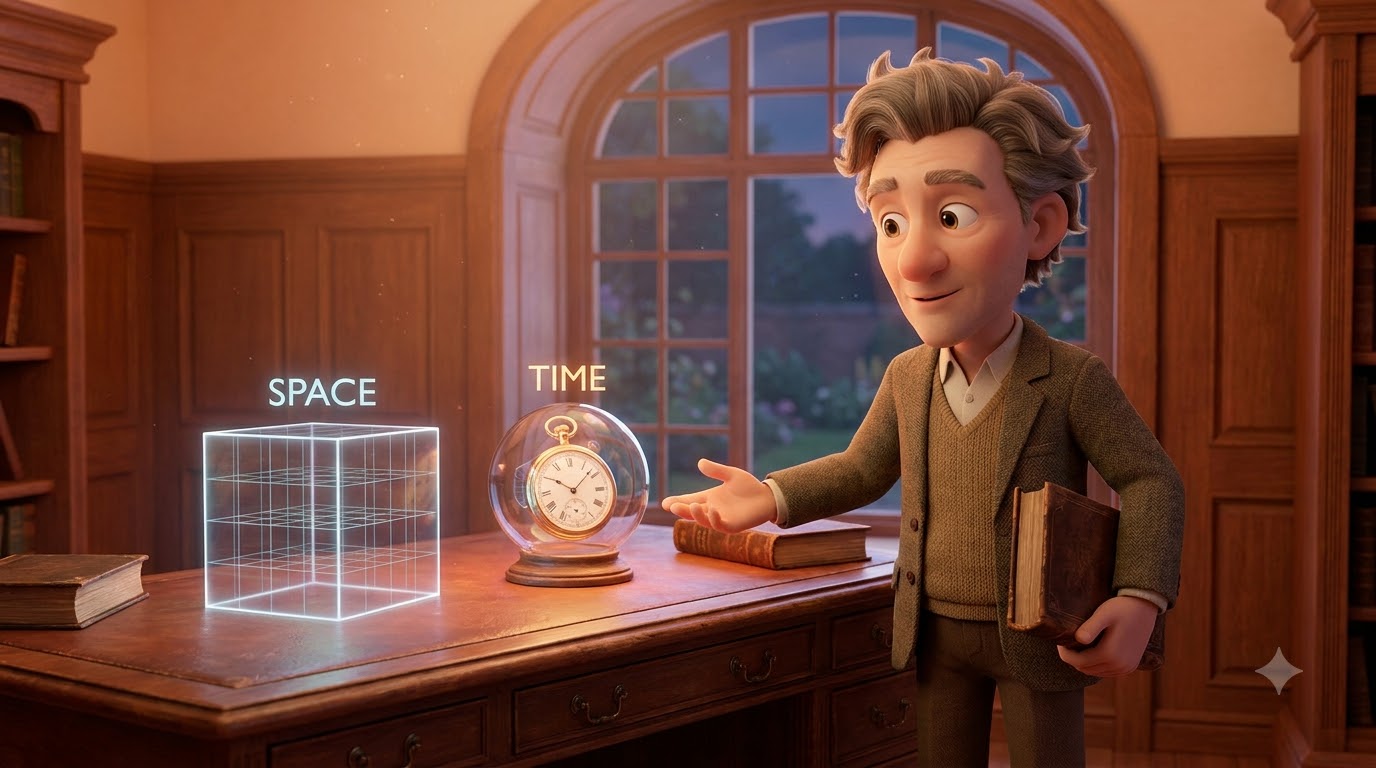
But one of the most profound discoveries in the history of science is that space and time are not two separate things. They are a single, unified fabric called spacetime — and the universe plays out on this fabric in ways that are stranger and more beautiful than anything our intuitions would suggest.
The Stage of the Universe
Before we get into relativity and warped geometry, let’s start somewhere familiar.
Imagine you’re arranging to meet a friend. To pin down the meeting, you need four pieces of information: where (three coordinates — say, the street, the floor of the building, and which room), and when (the time). It takes all four numbers to fully locate an event in the universe.
This is the essence of spacetime: any event in the universe can be pinpointed by four coordinates — three of space (length, width, height) and one of time. Together, these four dimensions form what physicists call 4-dimensional spacetime.
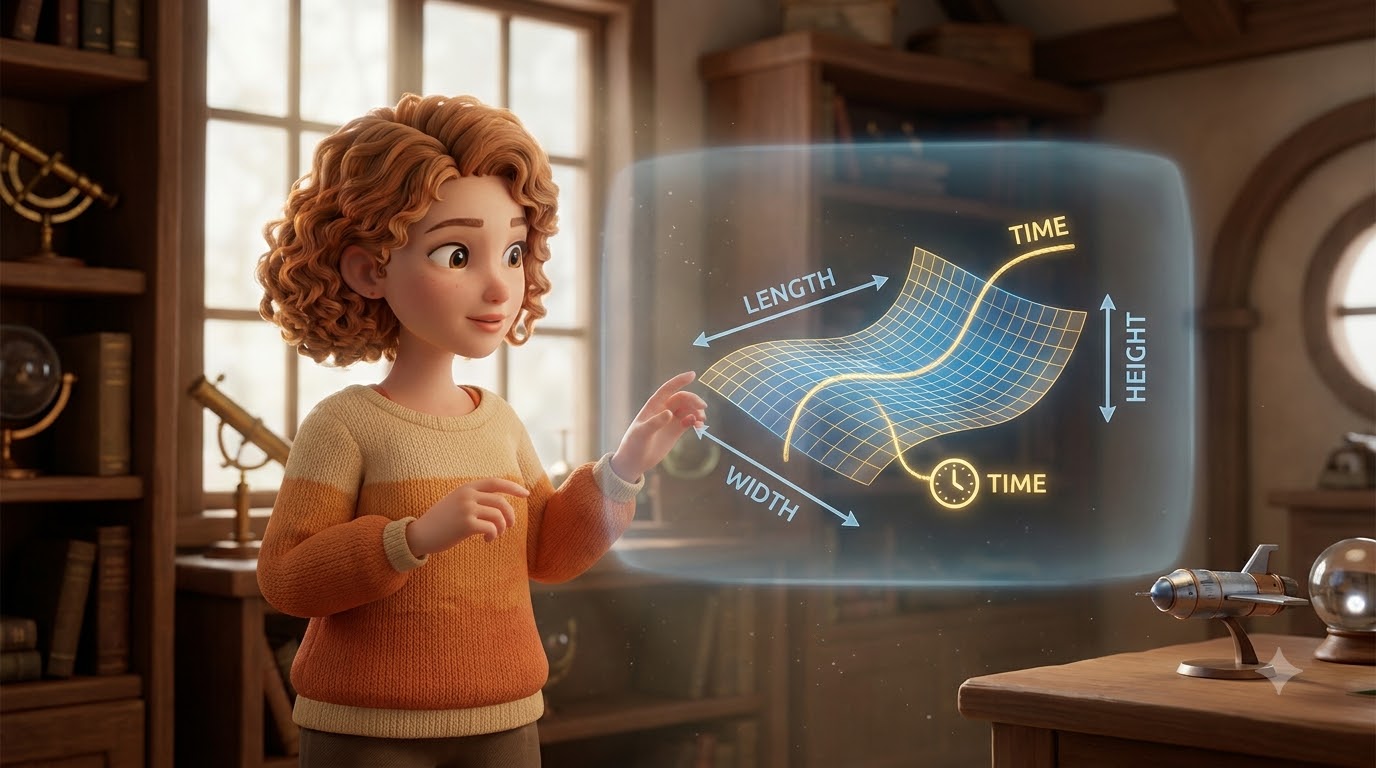
💡 Dimension simply means an independent direction you can move in. A flat page has two dimensions (left-right, up-down). A room has three. Spacetime adds time as the fourth.
Newton’s Universe: Space and Time are Separate
For most of history, scientists — including Isaac Newton — treated space and time as completely independent and fixed. In Newton’s worldview:
- Space was an infinite, rigid container — the same everywhere, for everyone.
- Time ticked at the same rate universally — a clock on Earth would always agree with a clock on Mars or in a distant galaxy.
This worked extraordinarily well. It explained falling apples, orbiting planets, and the tides. But by the late 1800s, cracks were beginning to show.
Einstein’s Revolution: Everything is Relative
In 1905, a 26-year-old patent clerk named Albert Einstein published a paper that changed physics forever. His Special Theory of Relativity introduced two deceptively simple ideas:
- The laws of physics are the same for everyone moving at a constant speed.
- The speed of light in a vacuum is always the same — roughly 300,000 km/s — no matter who measures it or how fast they’re moving.
The second point is the truly radical one. Common sense says: if you’re on a train moving at 100 km/h and you throw a ball forward at 50 km/h, someone on the platform sees the ball moving at 150 km/h. But light doesn’t work this way. Whether you’re at rest or zooming through space, you always measure light travelling at the same speed.
The only way to reconcile this with the laws of motion is to accept something startling: space and time must both stretch and compress depending on how fast you’re moving. They are not fixed, absolute quantities. They are two sides of the same coin.
In 1908, the mathematician Hermann Minkowski formalised this by merging them explicitly: “Henceforth space by itself, and time by itself, are doomed to fade away into mere shadows, and only a kind of union of the two will preserve an independent reality.”
An Analogy: The Stretchy Sheet
A popular and useful analogy is to imagine spacetime as a large, taut rubber sheet stretched flat.
Now place a heavy bowling ball in the centre. The sheet sags and curves around the ball. A marble rolling across the sheet will curve toward the bowling ball — not because some mysterious invisible force pulls it, but because the shape of the sheet guides its path.
This is how Einstein’s General Theory of Relativity (1915) reimagines gravity. Gravity is not a force that reaches across space, as Newton described it. Instead, massive objects curve spacetime, and other objects follow those curves.
The Earth orbits the Sun not because the Sun pulls on it across empty space, but because the Sun’s enormous mass warps spacetime, and the Earth travels along the straightest path it can through that curved geometry. That curved path, seen from our flat-space perspective, looks like an orbit.
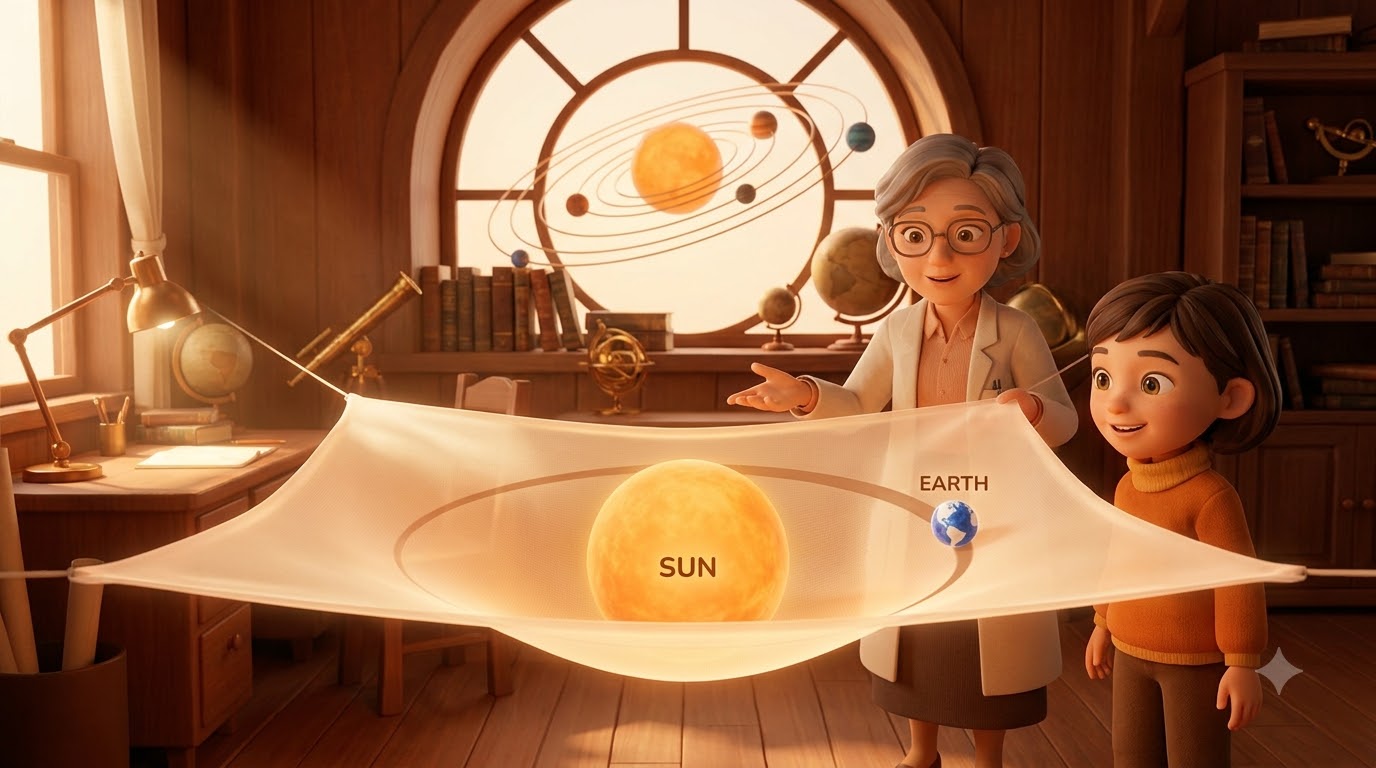
⚠️ A note on analogies: The rubber sheet is a helpful starting point, but it has limits. It’s a 2D surface showing only 2 spatial dimensions. Real spacetime is 4-dimensional, and it’s time that gets curved most dramatically near massive objects — not just space. Take the analogy as a stepping stone, not the full picture.
Time Dilation: Time Actually Slows Down
Here’s where things get genuinely mind-bending — and where the rubber sheet analogy starts to fall short, because it doesn’t show you what happens to time.
Special Relativity tells us that time passes more slowly for objects moving at high speeds. This is called time dilation. It’s not a trick of clocks; it’s a real physical effect.
An astronaut on the International Space Station, orbiting Earth at about 28,000 km/h, ages very slightly slower than someone on the ground. The difference is tiny — a fraction of a millisecond per day — but it is measurable and real. GPS satellites must actually correct for this effect to give accurate positions; without the correction, they would drift by kilometres per day.
General Relativity adds another layer: time also runs more slowly in stronger gravitational fields. A clock at sea level ticks slightly slower than one on a mountain, because it’s deeper in Earth’s gravitational well.
Near a black hole — the most extreme gravitational object known — this effect becomes dramatic. An observer hovering just outside a black hole’s event horizon (the point of no return) would experience time running at a tiny fraction of the rate measured by a distant observer.
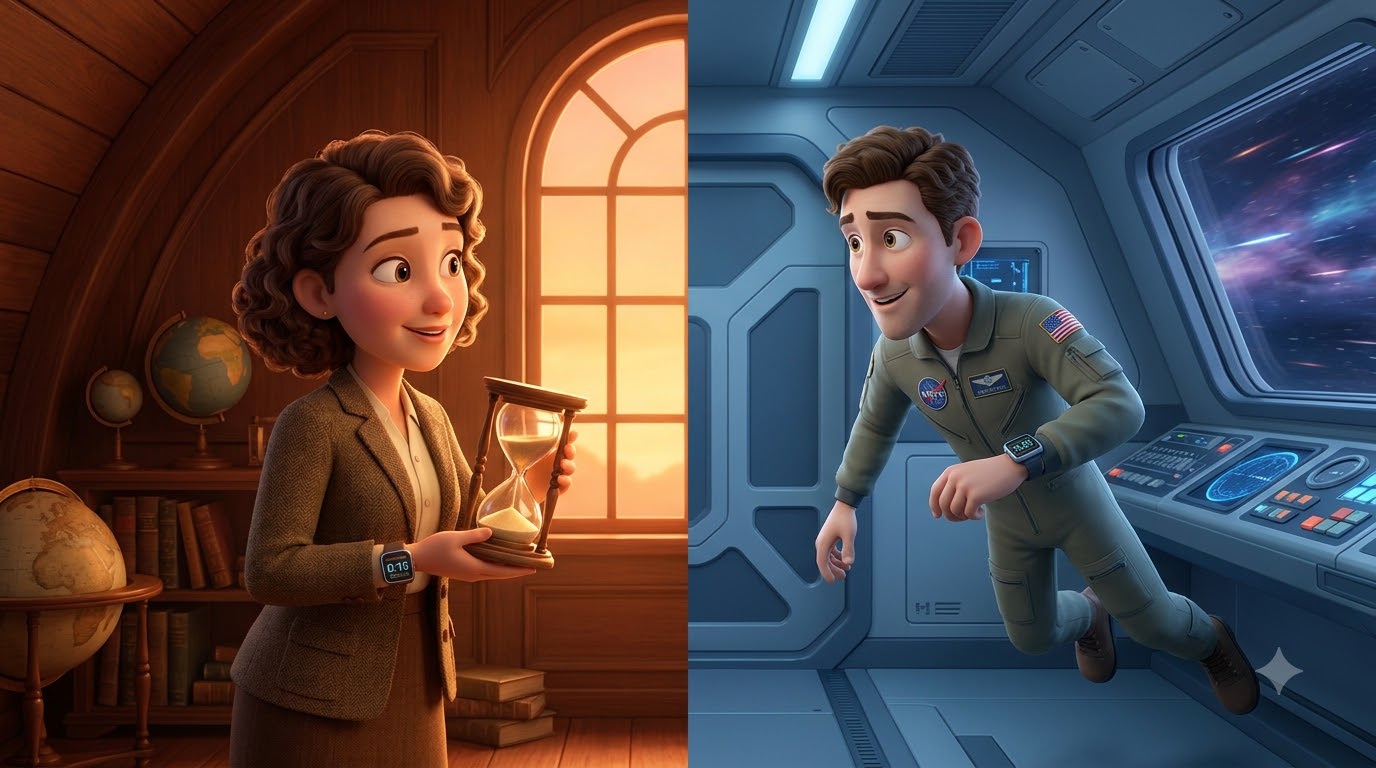
✅ Established fact: Time dilation has been measured precisely with atomic clocks on aircraft and satellites. It’s not speculation — it’s a verified, quantified effect that our technology depends on.
Gravitational Waves: Ripples in Spacetime
If massive objects warp spacetime, what happens when they move violently? They create gravitational waves — ripples in the fabric of spacetime itself, travelling outward at the speed of light.
Imagine dropping a stone into a still pond; ripples spread outward from the point of impact. Gravitational waves are the spacetime equivalent: disturbances in the geometry of the universe, generated by accelerating masses.
For most of the 20th century, gravitational waves were a prediction, not an observation. They are almost impossibly subtle — two black holes merging can produce a wave that stretches and squeezes the entire Earth by less than the diameter of a proton.
In September 2015, the LIGO observatory (Laser Interferometer Gravitational-Wave Observatory) detected gravitational waves for the first time, from the merger of two black holes over a billion light-years away. This was one of the most significant scientific confirmations of the 20th and 21st centuries, directly validating Einstein’s 100-year-old prediction and earning a Nobel Prize in Physics in 2017.
✅ Established fact: Gravitational waves have now been detected dozens of times by LIGO and Virgo. The sources include black hole mergers and neutron star collisions.
The Speed Limit of Spacetime
There is one absolute constant in spacetime: nothing that has mass can reach or exceed the speed of light. This isn’t an engineering limitation we’ll eventually overcome — it’s a fundamental consequence of spacetime geometry.
Here’s an intuitive way to think about it. In spacetime, every object is always “moving” through the four dimensions combined at the speed of light. If you’re sitting perfectly still in space, all of your spacetime motion is through time — that’s why time feels like it flows for you. As you move faster through space, you move less through time, which is why fast-moving objects experience time dilation. At the speed of light, all motion is through space, and time stops entirely.
This is why light doesn’t experience the passage of time — and why reaching the speed of light would require infinite energy for any object with mass.
What Spacetime Tells About Gravity
Let’s pull this all together with the most important takeaway:
In Einstein’s framework, gravity is not a force. It is the geometry of spacetime.
- Mass and energy warp spacetime.
- Everything in the universe — planets, light, even you — follows the straightest possible path through curved spacetime.
- We perceive those curved paths as the pull of gravity.
This explains something Newton’s gravity couldn’t: light bends around massive objects. Since light has no mass, Newton’s gravity shouldn’t affect it at all. But General Relativity predicts that the path of light curves through curved spacetime — and this was confirmed in 1919 when astronomers measured starlight bending around the Sun during a solar eclipse. This observation was one of the first great experimental validations of General Relativity.
Where the Story Gets Speculative
Spacetime as described by General Relativity is one of the best-tested theories in science. But it is not the final word.
General Relativity breaks down at the centre of black holes (called a singularity) and at the very beginning of the universe (the Big Bang). At these points, the equations produce infinities — a sign that the theory is incomplete for such extreme conditions.
Quantum mechanics, our equally successful theory of the very small (atoms, electrons, photons), describes a universe that is fundamentally different from the smooth, continuous spacetime of General Relativity. Reconciling the two — finding a theory of quantum gravity — is one of the deepest unsolved problems in all of physics.
Candidates such as string theory and loop quantum gravity propose that spacetime itself may be quantised (broken into tiny discrete units) at scales far smaller than anything we can currently probe, but these ideas remain hypotheses without direct experimental confirmation.
🔬 Speculation, not fact: Ideas about the quantum nature of spacetime, extra dimensions, or a multiverse are active areas of theoretical research. They are fascinating and well-motivated, but they are not established science in the way that Special and General Relativity are.
A Quick Summary
| Concept | What it means |
|---|---|
| Spacetime | Space and time unified into a single 4-dimensional fabric |
| Special Relativity | Moving observers experience time differently; the speed of light is constant |
| Time Dilation | Time runs slower at high speeds and in strong gravity |
| General Relativity | Mass curves spacetime; gravity is curved geometry, not a force |
| Gravitational Waves | Ripples in spacetime caused by accelerating masses; directly detected |
| Singularity | A point where General Relativity breaks down (e.g., inside a black hole) |
Why This Matters
Spacetime isn’t just an abstract idea for theoretical physicists. It has real, practical consequences:
- GPS technology only works because engineers correct for both special and general relativistic time dilation.
- Black hole imaging — including the first photograph of a black hole by the Event Horizon Telescope in 2019 — depends entirely on how light behaves in curved spacetime.
- Gravitational wave astronomy is opening an entirely new way to observe the universe, detecting events invisible to light.
Understanding spacetime is not merely understanding a theory — it is understanding the actual geometry of reality. The universe is not a fixed stage on which events unfold. The stage itself is dynamic, flexible, and intertwined with everything that happens upon it.
The fabric of existence is far stranger — and far more beautiful — than Newton ever imagined.
Further reading: Einstein’s original 1905 and 1915 papers are available in English translation. For a non-mathematical introduction, consider Kip Thorne’s Black Holes and Time Warps or Brian Greene’s The Fabric of the Cosmos.