The Strange Orbit of Mercury
Mercury does not orbit the Sun the way Newton said it should. For over half a century, its misbehaving path baffled the greatest minds in science — until Einstein showed that the answer was hidden in the fabric of spacetime itself.
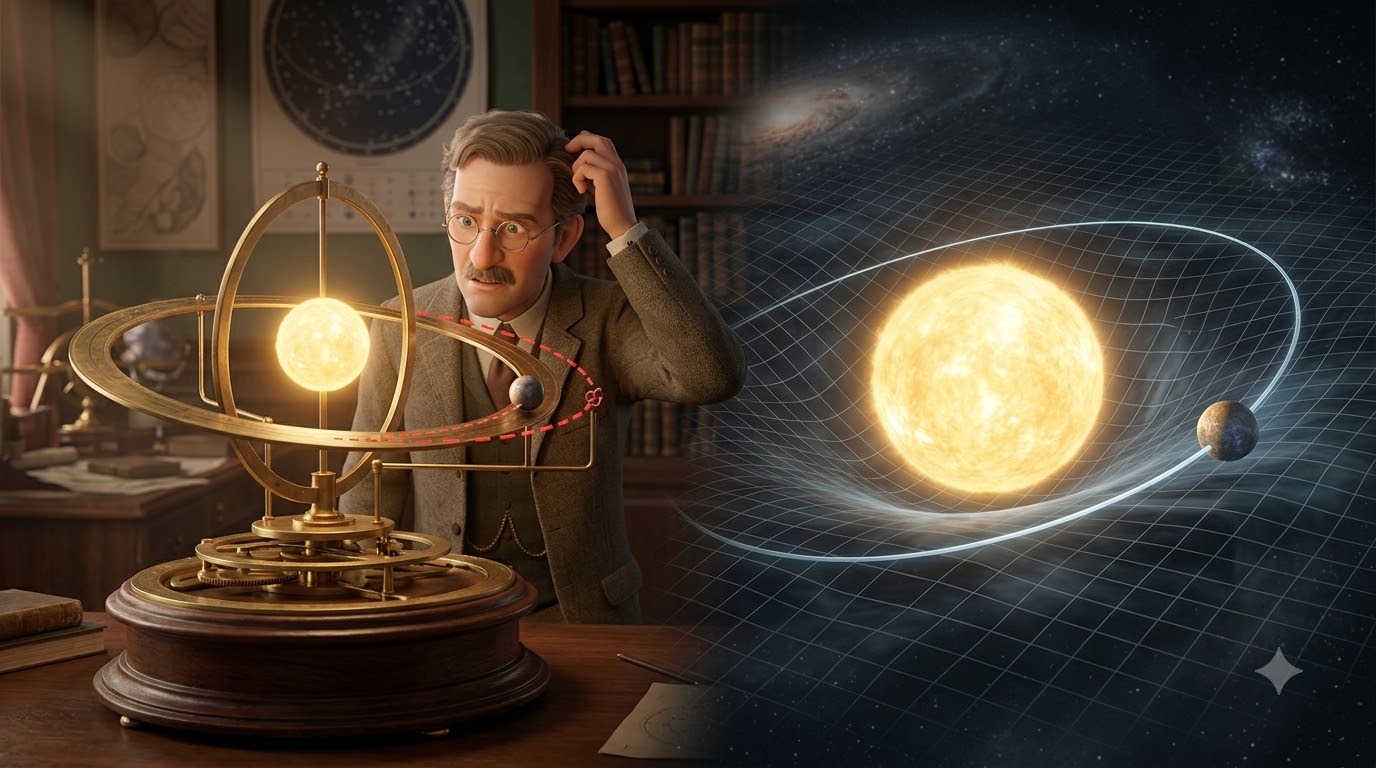
In November 1915, while finalising his General Theory of Relativity, Einstein applied his field equations to a concrete problem: the orbit of Mercury. The result was 43 arcseconds per century — the precise amount by which Mercury’s orbit had been observed to deviate from Newtonian predictions since Le Verrier first measured it in 1859.
Astronomers had tried for decades to account for that residual precession. Various explanations had been proposed — an undiscovered inner planet, a slight oblateness of the Sun, interplanetary dust — but none held up. Newton’s laws simply could not produce the right number.
General Relativity did, without any adjustable parameters. This article traces how that problem arose, and how Einstein’s geometry of spacetime resolved it.
Why Planetary Orbits Are Ellipses
To understand Mercury’s orbit, we first need to understand what an orbit is supposed to look like.
Johannes Kepler showed in the early seventeenth century that planets do not move in perfect circles — they move in ellipses: slightly squashed circles with the Sun sitting at one focus (not the centre). A planet moves faster when it is closer to the Sun and slower when it is farther away, sweeping out equal areas in equal times.
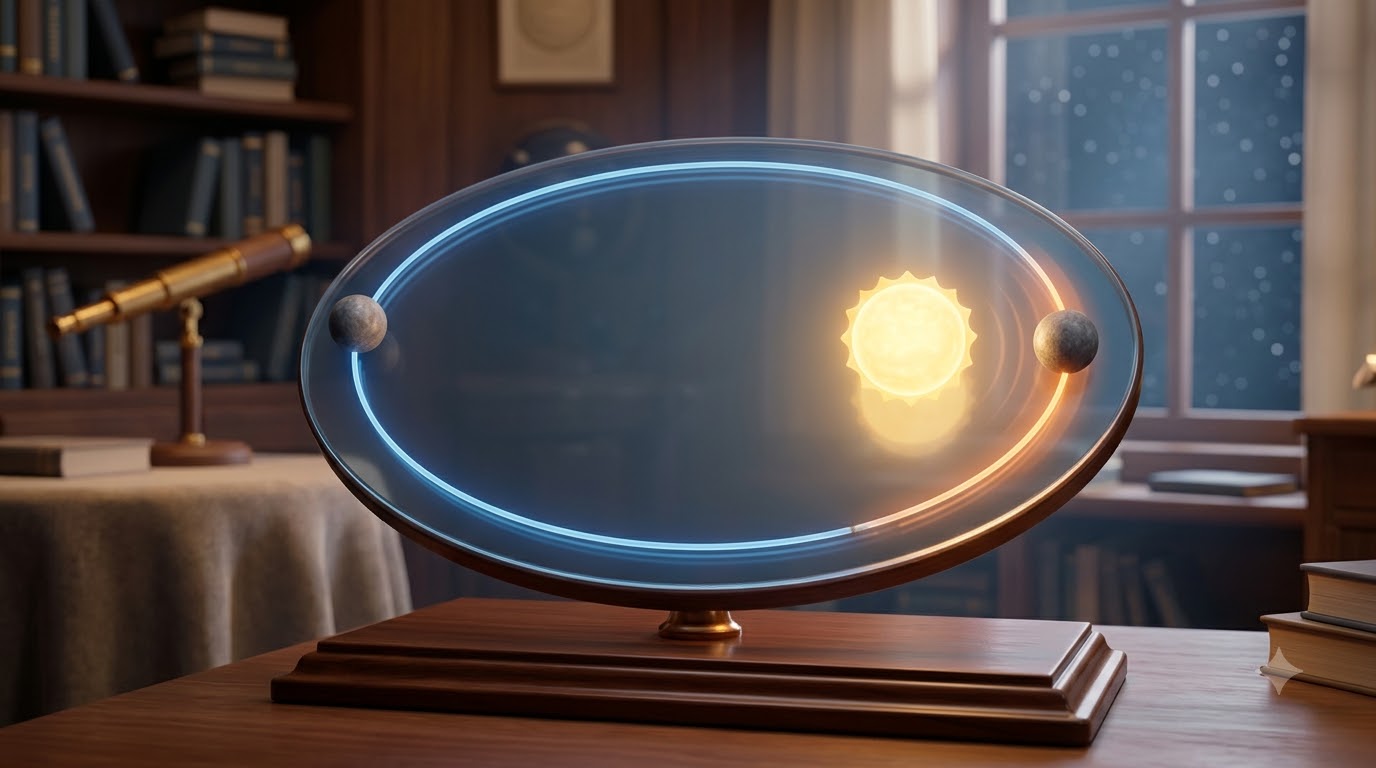
💡 Ellipse is a closed, oval-shaped curve defined by two focal points. The sum of the distances from any point on the ellipse to both foci is always the same. A circle is a special case of an ellipse where both foci are the same point. Planetary orbits are ellipses with the Sun at one focus.
The point in the orbit where a planet is closest to the Sun is called the perihelion (from the Greek: peri = near, helios = Sun). The point where it is farthest is the aphelion.
In a perfectly Newtonian universe with only two bodies — one planet and one Sun — the orbit is a perfect, fixed ellipse. The perihelion point returns to exactly the same place in space every year, year after year, forever.
The Problem: Mercury’s Orbit
Mercury is the innermost planet of our Solar System, and it is also the fastest: it completes one orbit every 88 Earth days. Because it is so close to the Sun, it moves at extraordinary speed — up to 59 kilometres per second at perihelion — and it is more strongly affected by the Sun’s gravity than any other planet.
Observations of Mercury going back centuries had established something puzzling: its perihelion does not stay in place. Each time Mercury swings around the Sun, its closest point is shifted slightly in the direction of its orbit. Over time, this drift means that the ellipse itself slowly rotates around the Sun like a spirograph pattern.
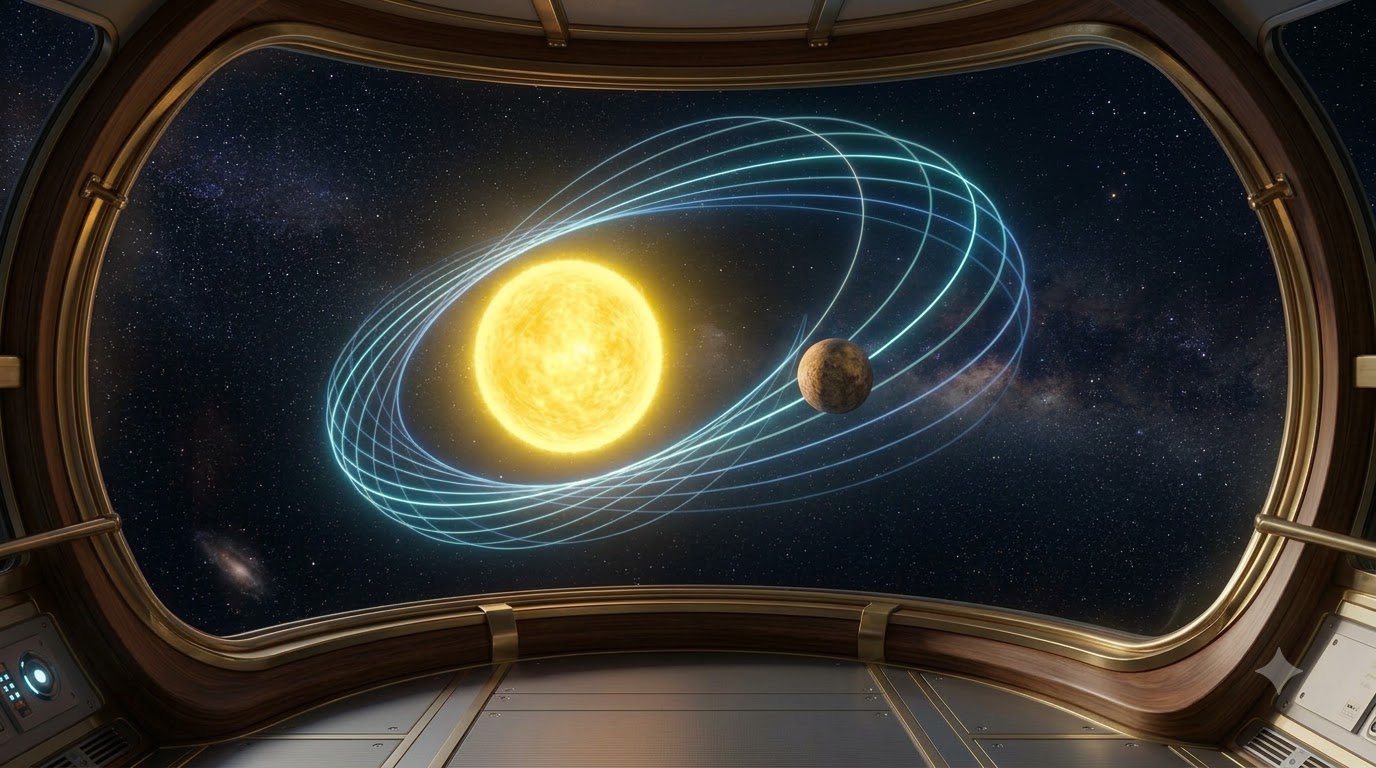
This rotation of an orbit is called precession — specifically, perihelion precession.
Now, precession is not in itself surprising. The Solar System is not a two-body problem. Jupiter, Saturn, Venus, and all the other planets tug on Mercury as it orbits, pulling it this way and that. These gravitational tugs shift Mercury’s perihelion over time in a predictable way.
Newton’s laws of gravity allow you to calculate exactly how much precession each planet contributes. When astronomers in the nineteenth century did this calculation carefully, they found that all the planets together produce a perihelion precession in Mercury of about 5,557 arcseconds per century — a tiny but measurable drift.
💡 Arcsecond is a unit of angular measurement. One full circle has 360 degrees. Each degree is divided into 60 arcminutes, and each arcminute into 60 arcseconds. One arcsecond is therefore 1/3,600 of a degree — so small that 43 arcseconds per century is barely perceptible even with sensitive instruments. Yet it was enough to upend physics.
When astronomers compared this prediction to actual observations, they found a discrepancy. The observed precession of Mercury’s orbit was 43 arcseconds more per century than Newton’s laws could account for.
Forty-three arcseconds is a fantastically small number — less than a hundredth of a degree every century. To put it in perspective: Mercury would need to complete about three million orbits before this drift added up to a full rotation of the ellipse. And yet this tiny residue sat on the books as an unexplained anomaly, a small thorn in the side of Newtonian mechanics.
The Search for Vulcan: A Missing Planet
The astronomer who first precisely quantified the anomaly was the French mathematician Urbain Le Verrier in 1859. Le Verrier was famous for a previous triumph: in 1846 he had predicted the existence and position of Neptune purely from the anomalous behaviour of Uranus’s orbit. Astronomers pointed their telescopes to the spot he indicated and found Neptune immediately.
Flushed with that success, Le Verrier applied the same logic to Mercury. If Mercury’s orbit was misbehaving, perhaps another planet — closer to the Sun than Mercury, and as yet undetected — was gravitationally tugging it along.
Le Verrier calculated where this hypothetical planet should be and gave it a name: Vulcan, after the Roman god of fire, a fitting choice for something lurking so close to the Sun. For the next several decades, astronomers searched. Some reported seeing it as a dark spot transiting the solar disc.
None of the reports held up to scrutiny. Vulcan was never found — because it does not exist. The failure to find Vulcan left the anomaly fully open. Newton’s gravity was incomplete — or the observations were wrong. Astronomers and physicists were certain the observations were right.
✅ Established fact: The search for Vulcan continued into the early twentieth century. When Einstein’s General Relativity precisely explained the 43-arcsecond anomaly in 1915, the motivation for Vulcan’s existence evaporated. The planet was definitively abandoned as unnecessary.
Why Mercury is Most Affected
Before turning to Einstein, it is worth asking: if Newton’s laws are slightly wrong, why do we see the problem most clearly in Mercury?
The answer is geometry and speed.
The relativistic correction to Newtonian gravity becomes larger the stronger the gravitational field and the faster an object moves. Mercury is the closest planet to the Sun, so it experiences the strongest solar gravity, and it is moving faster than any other planet. Both factors amplify the effect.
For Earth, the relativistic precession is about 3.8 arcseconds per century — small enough that it was not a serious observational problem in the nineteenth century, though it has since been precisely measured and confirmed. For Mercury, the effect is about 43 arcseconds per century — eleven times larger, and conspicuous enough to demand explanation.
💡 Think of it this way: relativistic effects are like a gentle but persistent current in a river. For a slow-moving boat far from the current’s strongest channel, the drift is negligible. But Mercury is a fast boat right in the middle of the flow — the effect is impossible to ignore.
Gravity as Curved Spacetime
The resolution came not from finding a new planet, but from rethinking what gravity is.
Newton’s gravity is a force: every mass attracts every other mass across empty space, with a strength that falls off as the square of the distance. It is a spectacularly successful description — but Newton himself never explained the mechanism. How does the Sun reach across 77 million kilometres of empty space and pull Mercury?
Einstein’s answer, arrived at through the Equivalence Principle and a decade of mathematical effort, is fundamentally different. Gravity is not a force acting across space. It is the curvature of spacetime — the four-dimensional fabric of the universe — caused by the presence of mass and energy. Objects don’t get pulled by gravity; they follow the straightest possible paths through a curved geometry.
💡 Spacetime is the combination of three dimensions of space and one dimension of time into a single four-dimensional framework. Einstein showed that space and time are not separate and absolute, but interwoven and relative to the observer. For more on this foundation, see our article What is Spacetime?.
Near a massive object like the Sun, spacetime is significantly curved. Mercury, as it orbits, is following the curved geometry of spacetime around the Sun — not responding to a force. Newton’s description of gravity is an excellent approximation to this curved-geometry picture, valid when gravitational fields are weak and velocities are small compared to light.
For most of the Solar System, the approximation is so good it is indistinguishable from the truth. But right in the deep gravitational well of the Sun, where Mercury moves fastest, the approximation breaks down just slightly — and that slight breakdown is precisely what the 43 arcseconds represent.
The Bigger Picture
By November 1915, General Relativity was still an unconfirmed theory. Einstein believed it deeply — his intuition about its mathematical elegance and internal consistency was strong — but science requires evidence, not belief.
The 43-arcsecond anomaly was a well-known, well-measured fact that had sat unsolved for 56 years. Einstein had not built his theory to explain Mercury. He had built it from first principles — from the Equivalence Principle, from the geometry of curved spacetime — and it explained Mercury for free.
This is what physicists call predictive power: a theory passes a much stronger test when it correctly accounts for something it was not designed to explain.
When the 1919 eclipse expedition confirmed that starlight bent around the Sun by exactly the amount General Relativity predicted, Einstein became world-famous overnight. But inside the physics community, the Mercury result had already done much of the convincing.
A Quick Summary
| Concept | What it means |
|---|---|
| Perihelion | The closest point in a planet’s elliptical orbit to the Sun |
| Precession | The slow rotation of a planet’s orbital ellipse over time |
| Anomalous precession | The 43 arcseconds per century of Mercury’s precession unexplained by Newtonian gravity |
| Vulcan | A hypothetical planet proposed in 1859 to explain the anomaly; never found |
| General Relativity | Einstein’s theory of gravity as the curvature of spacetime; explains the anomaly exactly |
Further reading: For the history and physics of Mercury’s precession, see Subtle is the Lord by Abraham Pais — the definitive scientific biography of Einstein — or The Hunt for Vulcan by Thomas Levenson, which tells the colourful story of the search for the phantom planet.