Death of a Massive Star
When a star much heavier than our Sun runs out of fuel, it does not quietly fade. It collapses in an instant and explodes with the energy of a billion suns — seeding the universe with the atoms that make up everything, including you.
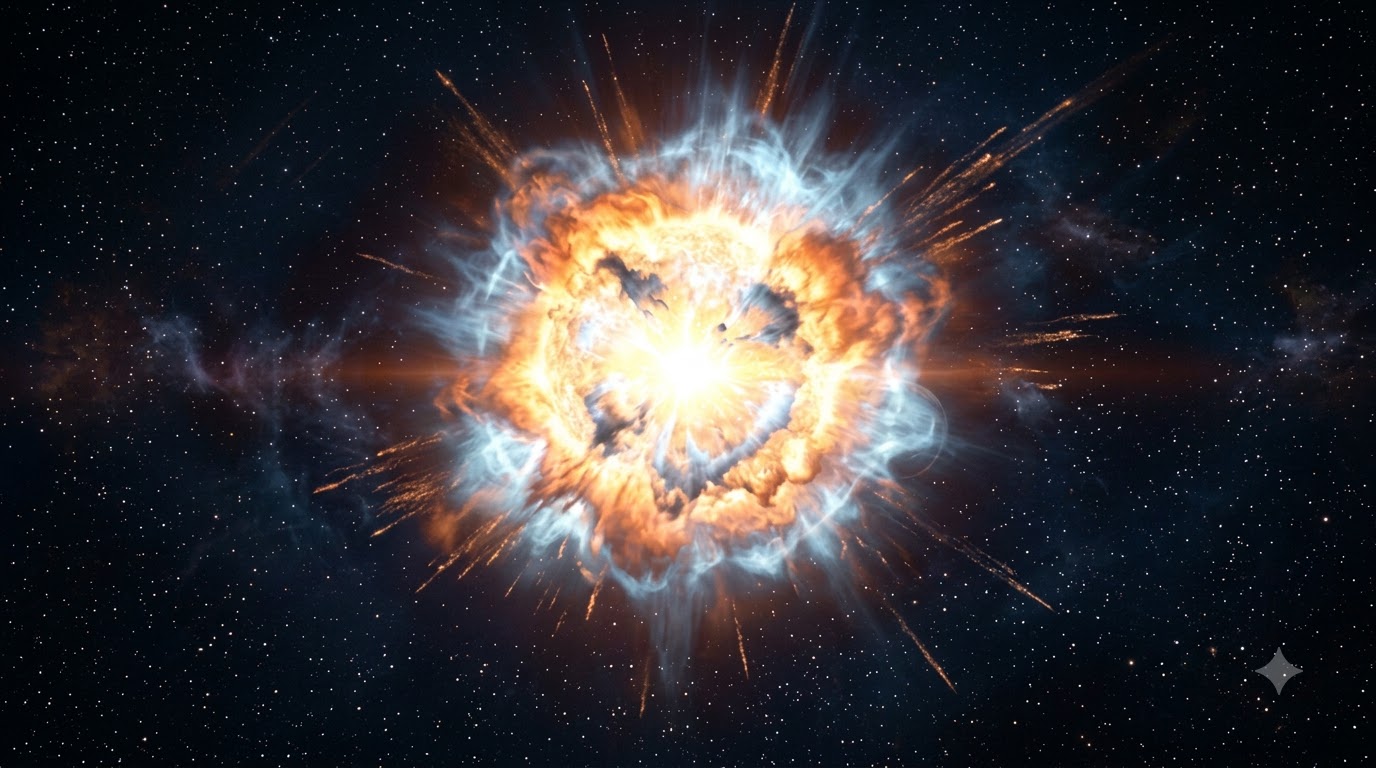
Every atom of iron in your blood, every calcium atom in your bones, every oxygen atom in each breath you draw — all of it was forged inside a star and scattered across space by one of the most violent events the universe produces.
The death of a massive star is not a quiet fadeout. It is a catastrophe of cosmic proportions: a collapse so sudden and so extreme that it releases, in a fraction of a second, more energy than our Sun will emit in its entire 10-billion-year lifetime. The resulting explosion — a supernova — is so bright it can outshine an entire galaxy of hundreds of billions of stars.
And at its heart lies a story of an ancient battle between two of nature’s most fundamental forces: nuclear pressure and gravity. For millions of years, the star wins. Then, in an instant, it loses.
The Life a Star Before It Dies
To understand how a massive star dies, we first need to understand how it lives.
A star is, at its core, a balancing act. Gravity pulls all of a star’s gas inward — trying to crush it into an infinitely dense point. What stops this is the energy released by nuclear fusion at the star’s centre, which generates an outward pressure that pushes back.
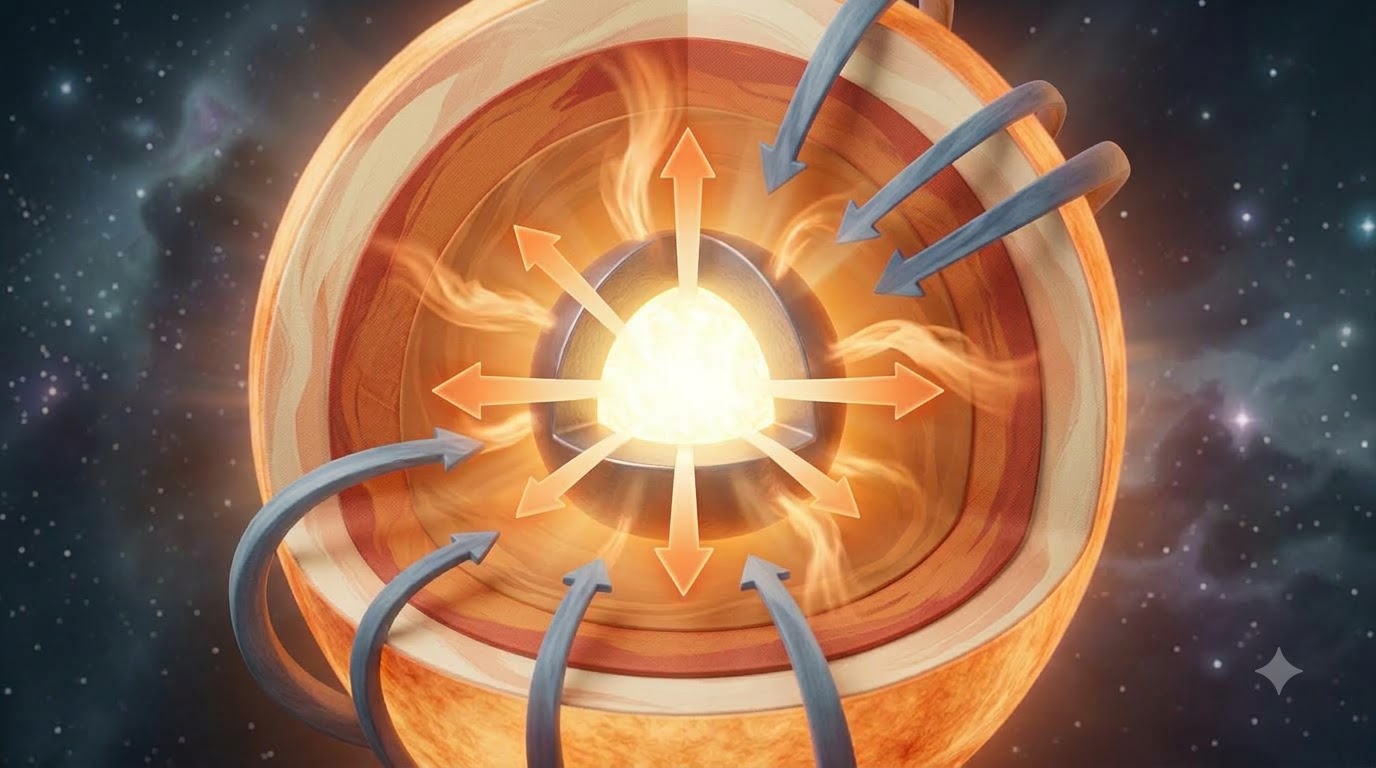
💡 Nuclear fusion is the process by which two light atomic nuclei are forced together under extreme heat and pressure to form a heavier nucleus, releasing energy in the process. It is the opposite of radioactive decay, which splits atoms. Stars are powered by fusion; the Sun converts about 600 million tonnes of hydrogen into helium every second.
The Sun — a middle-mass, middle-age star — has been doing this for about 4.6 billion years and will continue for roughly another 5 billion. But stars far more massive than the Sun burn brighter, hotter, and far faster. A star twenty times the Sun’s mass lives for only a few million years before it runs out of fuel. A star fifty times more massive may last only a few hundred thousand years.
The reason massive stars burn faster is gravity: more mass means more inward pressure, which means the core must run hotter to push back, which means it burns through fuel at a prodigious rate.
A Star’s Periodic Table
Here is where a massive star becomes one of the universe’s great factories.
As a massive star ages, it fuses heavier and heavier elements in successive shells around its core, like the layers of an onion. Each layer burns a different fuel:
- The outermost layers are still fusing hydrogen into helium.
- Deeper in: helium fuses into carbon and oxygen.
- Deeper still: carbon fuses into neon, sodium, magnesium.
- Further in: neon and then oxygen fuse into silicon and sulphur.
- At the very centre: silicon fuses into iron.
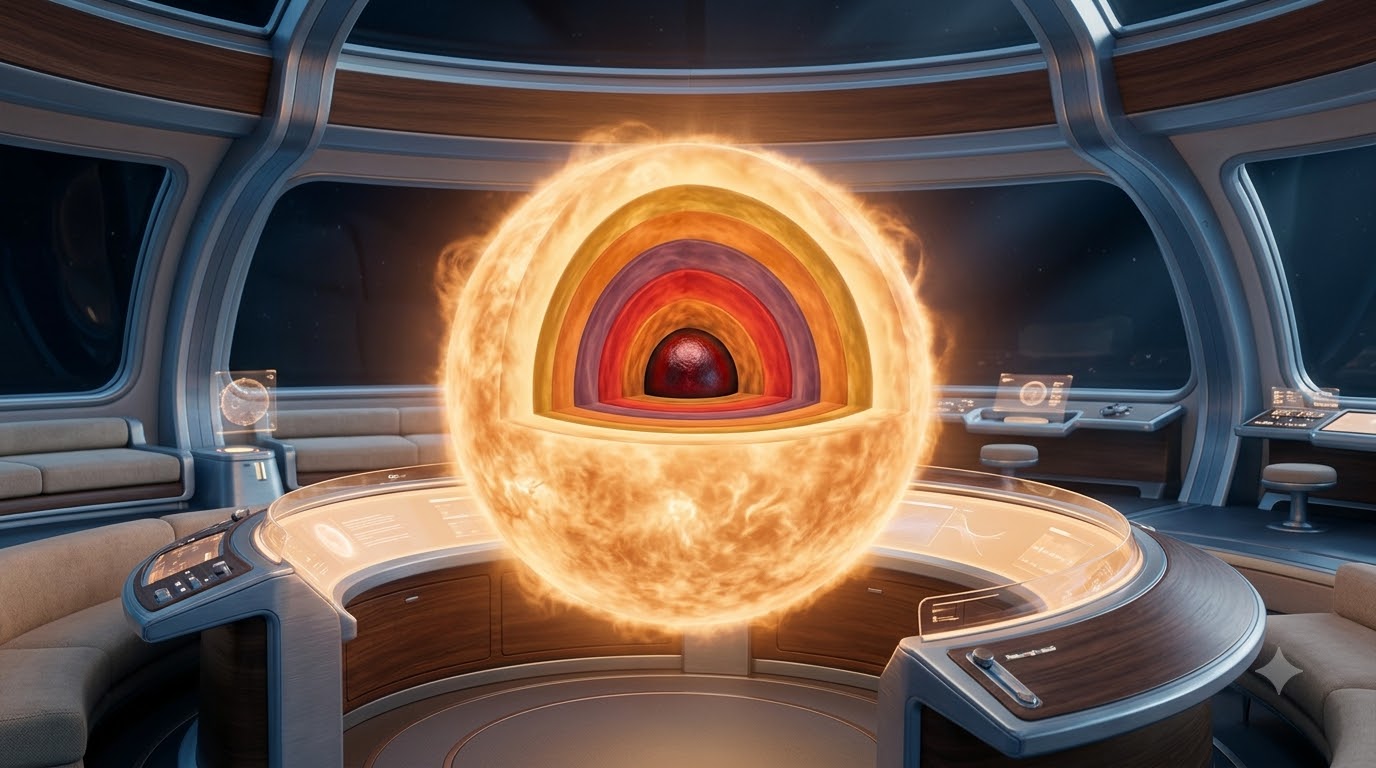
Each transition to a heavier fuel is a reprieve: a new fuel source that buys more time against gravity. But the transitions come faster and faster. Hydrogen burning in the core takes millions of years. Carbon burning takes a few thousand years. Neon burning: about a year. Oxygen burning: a few months. Silicon burning — the final stage — takes about a week.
The Iron Problem
Iron is special — and not in a good way for a star.
Every element up to iron releases energy when fused into something heavier. This is because the nuclear binding energy — the energy holding a nucleus together — increases as you go up the periodic table toward iron. Fusion releases the difference in binding energy, and that’s what powers a star.
But iron sits at the peak. Fusing iron into anything heavier absorbs energy instead of releasing it. Iron is nuclear ash — it cannot be used as fuel. It simply accumulates in the core, an inert, growing mass. Once the silicon burning is complete, the star’s iron core grows rapidly. There is nothing left to burn. Nuclear pressure — which has been holding the star up for its entire life — switches off.
Gravity, which has been waiting millions of years, wins instantaneously.
The Collapse: 0.1 Seconds to Catastrophe
What happens next is the fastest cataclysm in astrophysics.
The iron core, which has been growing to roughly 1.4 times the mass of our Sun, begins to collapse under its own weight. It falls inward at roughly a quarter of the speed of light. In less than a second — some models say in as little as 0.1 seconds — a core the size of the Earth compresses to a sphere roughly 20 kilometres across.
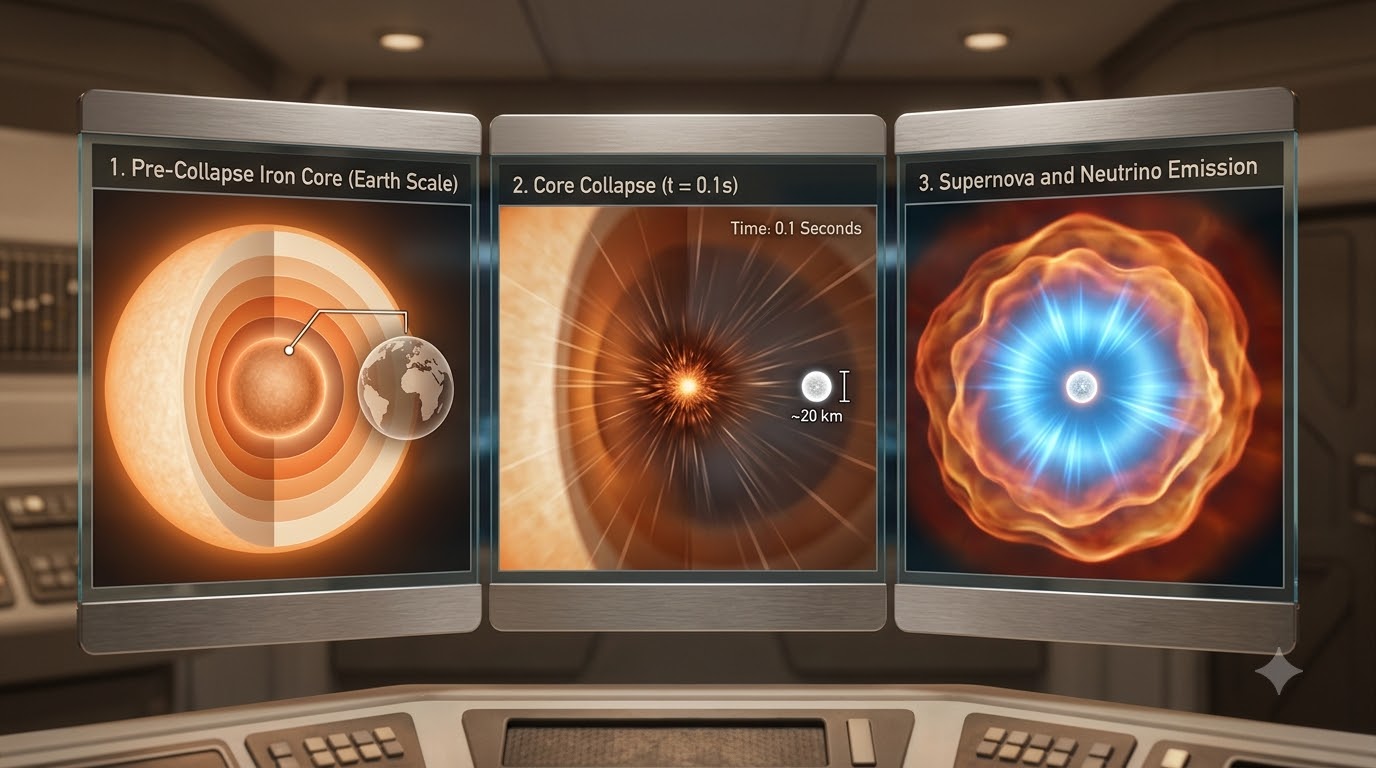
The density reached is extraordinary: nuclear density, the density at which atomic nuclei are packed tightly together with no space between them. At this density, matter behaves in an entirely new way. Electrons are forced into protons, converting them into neutrons and neutrinos. The neutrons themselves resist further compression through a quantum mechanical effect called neutron degeneracy pressure — a fundamental property of matter at extreme densities.
The collapsing core hits this density wall and bounces.
This bounce sends a powerful shockwave outward through the star at speeds approaching 30,000 km/s. The shockwave tears through the surrounding shells of the star, heating them violently. Heavy elements are synthesised in the chaos. The outer layers of the star — everything except the core — are flung into space.
This is a core-collapse supernova.
The Neutrino Flood
Here is one of the most remarkable facts about supernovae — and one of the hardest to intuitively grasp.
The entire energy released in a core-collapse supernova is roughly 3 × 10^46 joules — more than the Sun will release in its entire 10-billion-year lifetime. This is an almost incomprehensible number.
Of this, about 99% is carried away by neutrinos — ghostly, nearly massless particles that interact so weakly with ordinary matter that they stream straight through the entire star (and almost everything else) without being stopped. Only about 1% of the energy goes into the visible explosion, the shockwave, and the kinetic energy of the ejected material.
💡 Neutrinos are fundamental particles with almost no mass and no electric charge. They interact with ordinary matter only through the weak nuclear force, which makes them extraordinarily difficult to detect. Trillions of neutrinos from the Sun pass through your body every second without interacting with a single atom. Yet in the extreme density of a collapsing stellar core, even neutrinos are briefly trapped — and it is the pressure of their eventual escape that helps drive the supernova explosion.
In 1987, a supernova called SN 1987A exploded in the Large Magellanic Cloud, a satellite galaxy of the Milky Way, about 168,000 light-years away. Underground neutrino detectors around the world — including Kamiokande in Japan and IMB in the United States — detected a burst of 24 neutrinos from the event arriving about three hours before the optical brightening of the explosion became visible. This was the first direct detection of neutrinos from a stellar death and confirmed the core-collapse supernova model in extraordinary detail.
✅ Established fact: SN 1987A is the nearest supernova observed since the invention of the telescope, and the associated neutrino detection was a landmark confirmation of the theoretical models of stellar collapse. The detections earned a share of the 2002 Nobel Prize in Physics.
What the Explosion Leaves Behind
When the dust settles — literally, as the ejected material forms glowing clouds of gas and newly forged elements — two possible remnants can remain.
The Neutron Star
For stars roughly 8 to 20 times the Sun’s mass, the surviving core becomes a neutron star: one of the most extreme objects in the known universe.
- Mass: Typically about 1.4 times the Sun’s mass.
- Diameter: Roughly 20 kilometres — about the size of a city.
- Density: A teaspoon of neutron star material would weigh approximately a billion tonnes.
- Magnetic field: Billions of times stronger than any magnet on Earth.
Neutron stars can rotate hundreds of times per second. As a star collapses, it conserves angular momentum — the same effect that makes a spinning figure skater speed up when they pull in their arms. A slowly rotating star becomes a furiously spinning neutron star.
Some neutron stars emit beams of radio waves or X-rays from their magnetic poles. If those beams sweep past Earth like a cosmic lighthouse, we detect them as regular pulses — these are called pulsars. The first pulsar was detected in 1967 by Jocelyn Bell Burnell, who noticed a radio signal so regular that it was briefly labelled LGM-1 (“Little Green Men”) — until the astrophysical explanation became clear.
✅ Established fact: Hundreds of pulsars have been catalogued. Their extreme regularity makes them among the most precise natural clocks in the universe — in some cases rivalling atomic clocks in precision.
The Black Hole
For the most massive progenitor stars — those above roughly 20 to 25 times the mass of the Sun, though the exact threshold depends on many factors — even neutron degeneracy pressure is not enough to resist gravity. The core collapses further, past the neutron star stage, into a black hole: a point of infinite density (a singularity) surrounded by an event horizon, the point of no return from which nothing — not even light — can escape.
💡 Event horizon: The boundary around a black hole at which the escape velocity equals the speed of light. Anything crossing the event horizon cannot escape — not because it is physically blocked, but because spacetime itself is curved so severely that all paths lead inward. For more on how spacetime curvature works, see our article What is Spacetime?.
Not every massive stellar death produces a visible supernova if a black hole forms. In some cases, the collapse may be so complete — sometimes called a “failed supernova” or “direct collapse” — that the star dims and vanishes with little or no explosion. Observations of stars disappearing without a supernova have been reported, though the statistics are still limited.
The Expanding Nebula: A Star’s Afterlife
The ejected material from a supernova does not simply disappear. It expands outward for thousands of years, forming a glowing cloud of gas and debris called a supernova remnant.
The most famous example visible to the naked eye in historical records is the Crab Nebula — the remnant of a supernova observed by Chinese, Arab, and possibly Native American astronomers in 1054 CE, visible in daylight for several weeks. Today, the expanding cloud is about 11 light-years across and still expanding at about 1,500 km/s. At its centre sits the Crab Pulsar, a neutron star spinning 30 times per second.
Supernova remnants are not merely beautiful. They are the universe’s delivery mechanism for the elements.
Inside the remnant are all the elements the star forged across its lifetime: carbon, oxygen, silicon, iron — and, synthesised in the extreme heat of the explosion itself, heavier elements that cannot be made inside a living star: zinc, silver, iodine, gold, platinum, uranium, and more.
This material mixes with the surrounding interstellar gas and dust. Over millions of years, it may be swept into new collapsing clouds — the seeds of new stars and solar systems. Our own Solar System formed from a cloud of gas that was itself enriched by earlier generations of massive stars that lived and died before the Sun was born.
✅ Established fact: Isotopic signatures of short-lived radioactive elements (such as aluminium-26 and iron-60) found in meteorites confirm that a supernova occurred in our Sun’s neighbourhood shortly before the Solar System formed — possibly triggering the collapse that made our Sun and planets. This is a standard result in meteoritics and nuclear astrophysics.
You Are Made of Dead Stars
This is not poetry. It is astrophysics.
The hydrogen in your body is primordial — made in the first few minutes after the Big Bang. But almost every other atom in your body — the carbon in your DNA, the oxygen you breathe, the calcium in your skeleton, the iron in your haemoglobin — was forged inside a star and scattered by its death.
You are the product of at least one, and likely many, stellar deaths across billions of years of cosmic history.
The astrophysicist Carl Sagan expressed it this way: “The nitrogen in our DNA, the calcium in our teeth, the iron in our blood, the carbon in our apple pies were made in the interiors of collapsing stars. We are made of star stuff.”
A Quick Summary
| Concept | What it means |
|---|---|
| Core-collapse supernova | Explosion triggered when a massive star’s iron core collapses under gravity |
| Iron core | Nuclear ash that cannot be fused for energy; its formation ends a star’s life |
| Neutron star | Ultra-dense remnant: ~1.4 solar masses compressed into ~20 km diameter |
| Black hole | Remnant for the most massive stars; gravity collapses the core past neutron density |
| Pulsar | A rotating neutron star emitting beams of radiation — a natural cosmic clock |
| Supernova remnant | The expanding cloud of gas and newly forged elements left after a supernova |
| SN 1987A | The nearest modern supernova; first direct neutrino detection from a stellar death |
| Neutrinos | Carry ~99% of a supernova’s energy; nearly impossible to stop |
Why This Matters
The death of a massive star is not just a spectacular event at the end of a star’s life. It is one of the universe’s primary mechanisms for:
- Creating and distributing elements heavier than hydrogen and helium — everything that makes chemistry, geology, and biology possible.
- Triggering new star formation, as expanding supernova remnants compress nearby gas clouds into collapse.
- Producing extreme objects — neutron stars and black holes — that are laboratories for physics under conditions impossible to reproduce on Earth.
- Generating cosmic rays, high-energy particles that stream through space and were once a mystery that occupied physicists for decades.
Every time you look at the night sky and see a bright star, you are looking at a nuclear furnace that will eventually end — some quietly, some catastrophically. The massive ones, when they go, do not go quietly. They go with the most energetic explosions in the observable universe, and they seed the cosmos with the ingredients for everything that comes next.
Stellar death is not an ending. It is how the universe builds.
Further reading: For an accessible account of stellar astrophysics, see The Life and Death of Stars by Kenneth R. Lang, or Astrophysics for People in a Hurry by Neil deGrasse Tyson. For a deeper treatment of supernovae and neutron stars, see Black Holes & Time Warps by Kip Thorne.