The Speed of Causality
Why can nothing travel faster than light? The real answer has nothing to do with photons — it is about the deepest rule the universe enforces: causes must always come before their effects.

Imagine you receive a phone call from a friend, and they warn you about an accident — before the accident has happened. You swerve, avoid the crash, and the accident never occurs. But if the accident never happened, how did your friend call to warn you?
This is a causality paradox: a cause without its effect, an effect without its cause — the universe’s timeline folding back on itself. It sounds like science fiction. But understanding why this can never happen leads directly to one of the most profound and misunderstood facts in physics: the speed of light is not really about light at all.
It is the speed at which causes can reach their effects. It is the speed of causality itself.
Cause and Effect: The Universal Rule
Before we get to relativity, let’s think about something more basic.
Every event in physics has a cause. A ball moves because a force acted on it. A match ignites because heat reached it. A star explodes because its core collapsed. This chain of causes and effects is so fundamental that we rarely question it.

But hidden inside this chain is a constraint: for something to cause something else, it must be able to reach it. Information, force, influence — whatever connects the cause to the effect — must physically travel from one place to another. And that travel takes time.
This is the key. If you could send a signal infinitely fast — or faster than some universal speed limit — you could, in principle, send information backwards in time, creating paradoxes where effects precede their causes. The universe, as far as we can tell, simply does not allow this. There is a speed limit. And that limit turns out to be approximately 299,792 km/s — the speed of light in a vacuum.
It’s Not Really About Light
Here is where most introductions to this topic mislead you. We call it “the speed of light,” which naturally makes people think: what’s so special about light? Why should photons get to set the universal speed limit?
The answer is: light doesn’t set the limit. Light simply travels at the limit, for a specific reason. The real rule, encoded in Einstein’s Special Theory of Relativity (1905), is this:
There is a maximum speed at which any cause can influence any effect. This speed is the same for all observers, in all directions, in all states of motion. It is approximately 299,792 km/s.
Light travels at this speed because photons — the particles of light — have exactly zero mass. In Special Relativity, anything with zero mass is forced to travel at this maximum speed. Massless particles cannot go slower, just as massive particles cannot go faster.

Think of it this way: the universe has a cosmic speed limit posted on every stretch of spacetime. Light happens to be the vehicle that always drives at exactly that limit. But the limit itself would exist even in a universe with no light at all.
💡 Photon is a particle of light with zero mass and zero electric charge. Because it is massless, it must travel at exactly the universal speed limit — no more, no less.
The Strange Logic of Relative Motion
To understand why there must be a speed limit at all, we need to think carefully about how speed works.
Suppose you are on a train moving at 100 km/h. You throw a ball forward at 50 km/h relative to the train. A person on the platform sees the ball moving at 150 km/h. This is ordinary Newtonian addition of velocities — speeds simply add up.
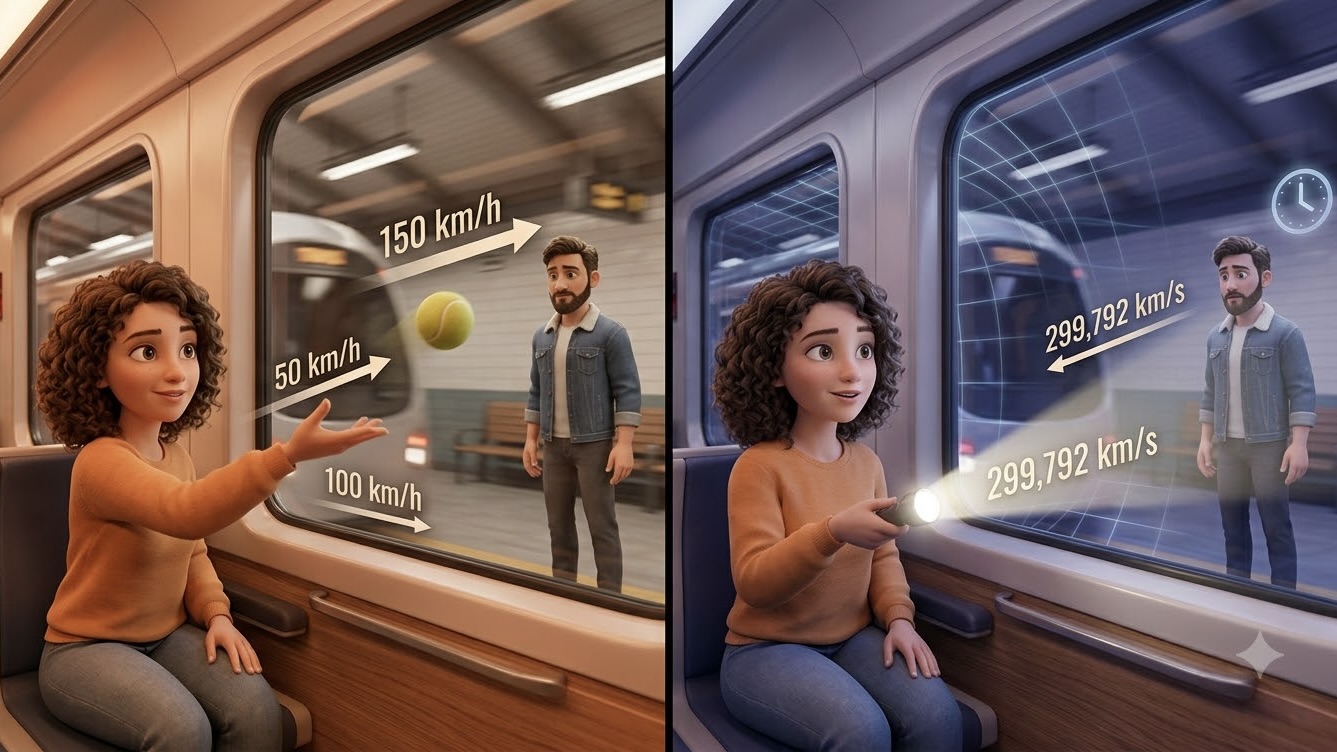
Now suppose, instead of a ball, you shine a flashlight forward. The light travels at 299,792 km/s relative to you on the train. By Newtonian logic, the person on the platform should see the light moving at 299,792 km/s plus the train’s speed.
But that is not what happens. The person on the platform measures the light moving at exactly 299,792 km/s — the same as you measured. Not a fraction more.
This was the experimental reality that forced Einstein to rethink everything. Light’s speed doesn’t add. It is the same for everyone, always, regardless of how fast the source or observer is moving.
The only way to make this consistent — to have the same speed measured by all observers — is for space and time themselves to stretch and compress depending on how fast you’re moving. This is the core of Special Relativity: space and time are not fixed, absolute quantities. They are flexible, and they bend to keep the speed of light constant.
The Geometry of Cause and Effect
Here is where the idea becomes truly deep. In spacetime — the four-dimensional fabric of the universe — every pair of events has what physicists call a spacetime interval. This interval tells you something crucial: are the two events close enough together in space, and far enough apart in time, that a signal moving at or below the speed of light could travel from one to the other?
Physicists classify the relationship between any two events into three categories:
| Relationship | What it means | Can one cause the other? |
|---|---|---|
| Timelike | The events are close enough in space that a signal slower than light can connect them | Yes — cause and effect can be linked |
| Lightlike | Only a signal moving at exactly the speed of light could connect them | Yes — connected by a light signal |
| Spacelike | The events are so far apart in space that even light cannot travel between them in the available time | No — they cannot causally influence each other |
The boundary between timelike and spacelike regions defines what physicists call the light cone — a geometric structure in spacetime that maps out every event a given point can causally influence, and every event that can causally influence it.
Your entire causal past — every event that has ever been able to send a signal to you — lies inside your past light cone. Your entire causal future — every event you could possibly influence — lies inside your future light cone.
Everything outside your light cone is causally disconnected from you. Not merely unreachable by current technology — fundamentally, by the laws of physics, unable to affect you or be affected by you.
Why Can’t Anything Massive Go Faster?
This is a question worth answering directly, because the answer is both practical and geometric.
In Special Relativity, as an object with mass accelerates, it gains what physicists call relativistic momentum — and the faster it goes, the more energy it takes to accelerate it further. As its speed approaches the speed of light, the energy required to go any faster approaches infinity.
This is not an engineering problem. No sufficiently powerful engine would solve it. It is a fundamental geometric feature of spacetime. The equation is exact:
The energy required to push a massive object to exactly the speed of light is literally infinite. There is no finite amount of energy in the universe sufficient to do it.
Massless particles like photons sidestep this by having zero mass — they were never going slower to begin with. But anything with mass is barred from reaching the limit entirely.
⚠️ Common misconception: People sometimes wonder whether we could just “build a better rocket.” No. The energy barrier is not technological — it is mathematical. As you approach the speed of light, each extra km/s requires exponentially more energy. The limit is geometrically fundamental, not practically inconvenient.
What About Quantum Entanglement?
At this point, many readers have heard something that sounds like a counterexample: quantum entanglement.
When two particles are quantum mechanically entangled, measuring one of them instantly affects the state of the other — even if they are on opposite sides of the universe. Doesn’t this send information faster than light?
No. And this is one of the most important “no” answers in physics.
Here’s why. When you measure an entangled particle, you get a random result — say, spin-up or spin-down. Your partner, measuring their particle far away, also gets a random result. The remarkable thing is that these random results are correlated: if you got spin-up, they got spin-down, every time.
But you cannot choose what result you get. The outcome is random. So you cannot use it to send a message. Your partner sees only random results on their end until they physically receive your list of outcomes through a normal channel — one limited by the speed of light — and compare.
The correlations are real, strange, and verified by experiment. But no information travels faster than light. Causality is intact.
✅ Established fact: Quantum entanglement has been verified experimentally many times since the 1970s. It produces correlations that cannot be explained by classical physics, but it cannot be used to transmit information faster than light. This has been proven as a theorem in quantum information theory.
Does Anything Exceed the Speed of Light?
Yes — but none of these things carry causality, so none of them violate it. Here are the main examples:
1. The expansion of the universe. Distant galaxies are receding from us at speeds greater than the speed of light due to the expansion of space itself. This is not objects moving through space; it is space stretching. No information is carried. The Milky Way and a galaxy a billion light-years away are not exchanging signals in this process.
2. The phase velocity of waves. In certain optical setups, the phase of a wave — a pattern, not a carrier of information — can propagate faster than light. But no signal, no data, no causal influence travels faster.
3. Shadows and laser spots. If you shine a laser at the Moon and sweep it quickly, the dot of light on the Moon’s surface can move faster than light. But the dot is not an object or a signal — it is a pattern of illuminated points. No individual photon moves faster than light.
In every case, physicists have looked carefully, and the conclusion is the same: nothing that carries information, influence, or causality exceeds the speed of light.
The Relativity of Simultaneity
There is one more implication of the cosmic speed limit that is worth understanding, because it is deeply counterintuitive.
If there is a maximum speed at which causes can travel, then two observers moving at different velocities will often disagree about whether two events happened simultaneously — or even, for spacelike-separated events, which one happened first.
This is the relativity of simultaneity: the order of events can depend on the observer’s state of motion. But crucially, this only applies to spacelike-separated events — events that cannot causally influence each other anyway. For events that are timelike-connected (cause and effect), every observer, no matter how fast they are moving, agrees on the order. The cause always precedes the effect.
The speed of light thus acts as a kind of guardian: it ensures that all observers, everywhere, in any state of motion, agree on the causal structure of the universe. What happened before and what happened after a causally connected pair of events is a fact that is the same for everyone.
A Quick Summary
| Concept | What it means |
|---|---|
| Speed of causality | The maximum speed at which any influence can travel — ≈ 299,792 km/s |
| Speed of light | Equal to the speed of causality; light is massless, so it travels at this limit |
| Light cone | The region of spacetime causally reachable from a given event |
| Timelike interval | Two events close enough that a signal can connect them — causal links possible |
| Spacelike interval | Two events too far apart for any signal — no causal link possible |
| Relativity of simultaneity | Different observers may disagree on event order, but only for causally disconnected events |
| Quantum entanglement | Produces instant correlations, but carries no information — causality is preserved |
Why This Matters
The speed of causality is not an engineering obstacle waiting to be engineered around. It is the structural backbone of the universe’s timeline.
Without it, the entire concept of before and after would become meaningless. Effects could precede their causes. History could loop back on itself. The past could be changed. The laws of physics as we understand them would collapse entirely.
The cosmic speed limit is not a prison. It is what makes coherent, consistent reality possible.
When Einstein’s Special Relativity set this limit into the foundations of physics, it was not narrowing down what the universe can do. It was revealing what the universe fundamentally is: a four-dimensional spacetime in which cause and effect are woven into the geometry itself — and in which one number, 299,792 km/s, stands as the invariant constant that holds it all together.
Further reading: For a deeper and accessible treatment of Special Relativity and causality, see Why Does E=mc²? by Brian Cox and Jeff Forshaw, or Six Not-So-Easy Pieces by Richard Feynman. For the role of causality in quantum mechanics, try Something Deeply Hidden by Sean Carroll.