The Equivalence Principle
Why does a falling astronaut feel weightless? Why does gravity slow down time? It all starts with one brilliantly simple idea Einstein called his 'happiest thought' — and it changed physics forever.
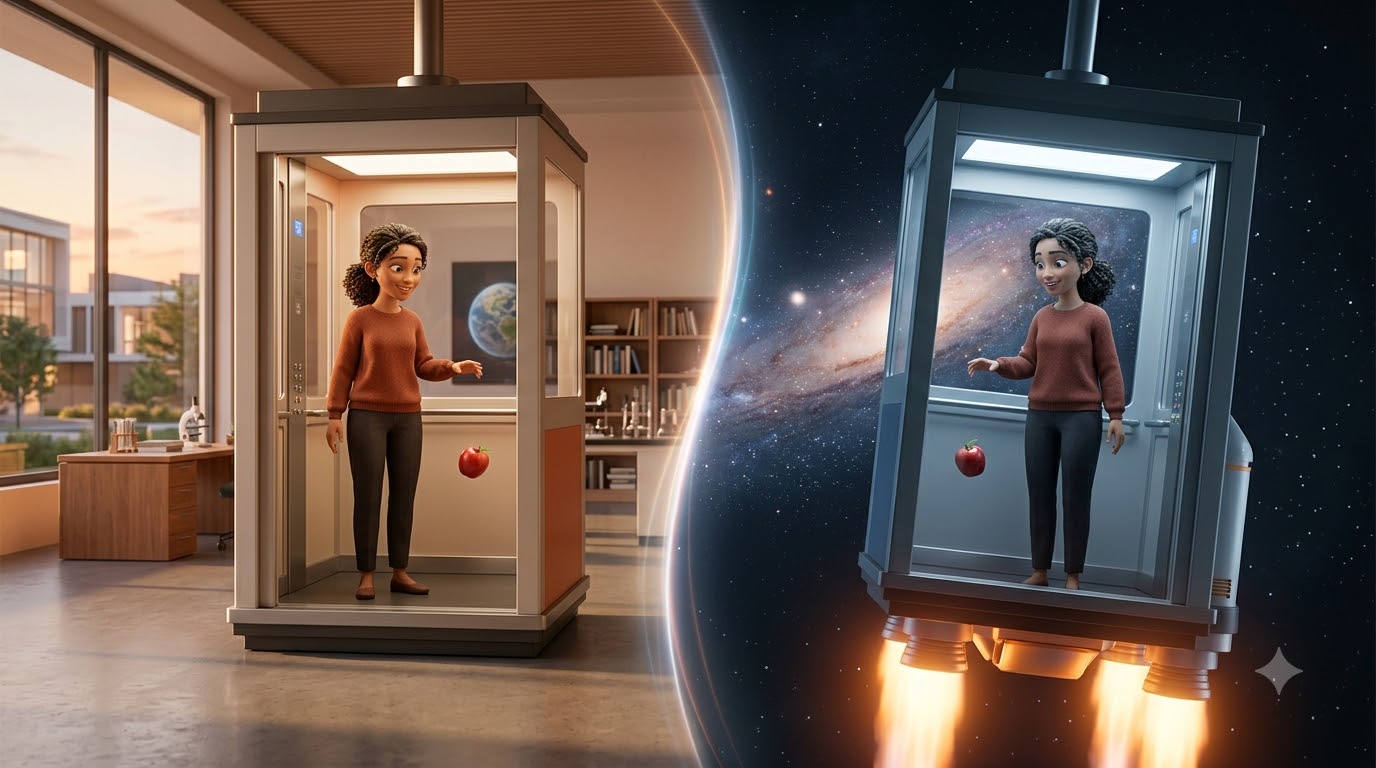
Imagine you wake up inside a windowless room — a sealed box with no way to see outside. The floor pushes against your feet. Objects fall when you drop them. Everything feels perfectly normal.
But here’s the question Einstein asked: how would you know whether that room is sitting still on Earth, or accelerating through empty space on a rocket?
The answer, as far as any experiment you could do inside the room is concerned, is: you wouldn’t. You can’t tell the difference.
That single observation — so simple it sounds almost trivial — turned out to be the seed of one of the most profound ideas in all of physics: the Equivalence Principle. It is the conceptual foundation of Einstein’s General Theory of Relativity, and it reshapes our entire understanding of gravity.
What is Gravity, Really?
Before Einstein, Isaac Newton had given us a serviceable description of gravity. His law of universal gravitation said that every object with mass attracts every other object with mass — the more massive, and the closer together, the stronger the pull. It worked spectacularly well. It predicted planetary orbits, explained falling apples, and guided the calculations of astronomers for two centuries.
But Newton himself admitted he didn’t know why gravity worked. It seemed to act instantly across vast distances of empty space, with no mechanism, no carrier, no explanation. Newton called this “action at a distance” and described it as unsatisfying.
Einstein wanted to understand gravity more deeply. And his starting point wasn’t complicated mathematics — it was a thought experiment about a falling elevator.
The Happiest Thought
In 1907, two years after his Special Theory of Relativity, Einstein was sitting in the patent office in Bern when a thought struck him. He later described it as “the happiest thought of my life.”
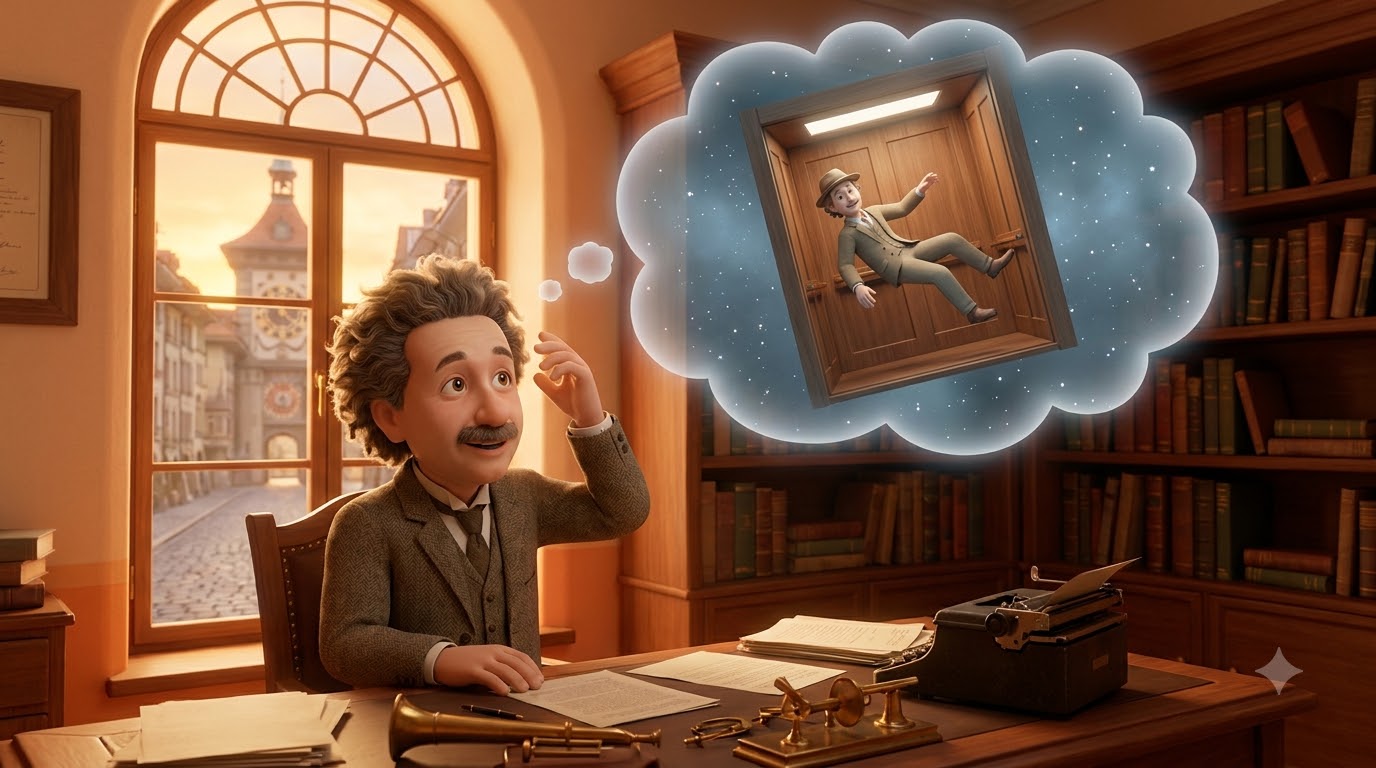
The thought was this: a person falling freely under gravity feels no gravity at all.
Think about it. When you fall — really fall, in free fall with nothing stopping you — you don’t feel your own weight. Astronauts orbiting Earth aren’t in a gravity-free region; they’re in free fall around the planet. But inside the International Space Station, everything floats. Water forms spheres. People drift. Drop a ball inside the cabin, and it just… stays where you left it.
This is not a trick. Their weightlessness is real and total, even though Earth’s gravity is pulling on them strongly. The reason is that the station and everything inside it are all falling together at exactly the same rate.
💡 Free fall means falling under gravity with nothing else acting on you — no air resistance, no floor. Orbiting a planet is a form of free fall: you’re constantly falling toward the planet, but moving sideways fast enough that you keep missing it.
Gravity and Acceleration
Einstein’s key insight was the flip side of this observation. If gravity and free fall cancel out perfectly, then gravity and acceleration must be, in some deep sense, the same thing.
More precisely, he formulated the Equivalence Principle as follows:
The effects of gravity are locally indistinguishable from the effects of acceleration.
“Locally” is an important word here. It means inside a small enough region, over a short enough time. This matters, and we’ll come back to it.
Let’s see what this means concretely with two scenarios:
Scenario A: You’re in a rocket in deep space
Far from any planet or star, your rocket accelerates upward at 9.8 metres per second squared. You stand on the floor of the rocket. The floor pushes up on your feet. You feel a downward force — just like standing on Earth. You drop a ball; it falls to the floor. Everything behaves exactly as if you were in Earth’s gravity.
Scenario B: You’re in a room on Earth
You stand on the floor. The floor pushes up on your feet. You feel a downward force. You drop a ball; it falls to the floor.

No experiment you perform inside either room — measuring forces, timing pendulums, watching falling objects — can distinguish scenario A from scenario B. They are, locally, physically equivalent.
The “Locally” Caveat
There’s a subtlety Einstein was careful about: the equivalence only holds locally — in a small enough region of space.
If you’re in a very large room on Earth, and you release two balls at exactly the same height but separated horizontally, something curious happens: they don’t fall perfectly parallel to each other. They fall very slightly toward each other, because both are being pulled toward the Earth’s centre, which is a single point. These tiny convergences are called tidal effects (the same physics that causes ocean tides).
In a uniformly accelerating rocket, two balls released side by side would fall perfectly parallel — no convergence. This is why physicists say “the equivalence is local” — it holds perfectly in a small enough region, but breaks down over large distances.
The full General Theory of Relativity goes beyond the local equivalence and accounts for these tidal effects as the curvature of spacetime.
⚠️ A note on precision: The Equivalence Principle is a cornerstone of General Relativity, but it’s also an ongoing area of experimental testing. So far, no experiment has detected any violation of it.
A Consequence: Light Must Bend in Gravity
If gravity and acceleration are equivalent, then anything acceleration does to light, gravity must also do. This leads to a remarkable prediction.
Imagine our rocket accelerating upward. A beam of light is fired horizontally across the cabin. By the time it reaches the opposite wall, the rocket has moved upward — so the light appears to have curved downward relative to the rocket. In an accelerating rocket, light follows a curved path.
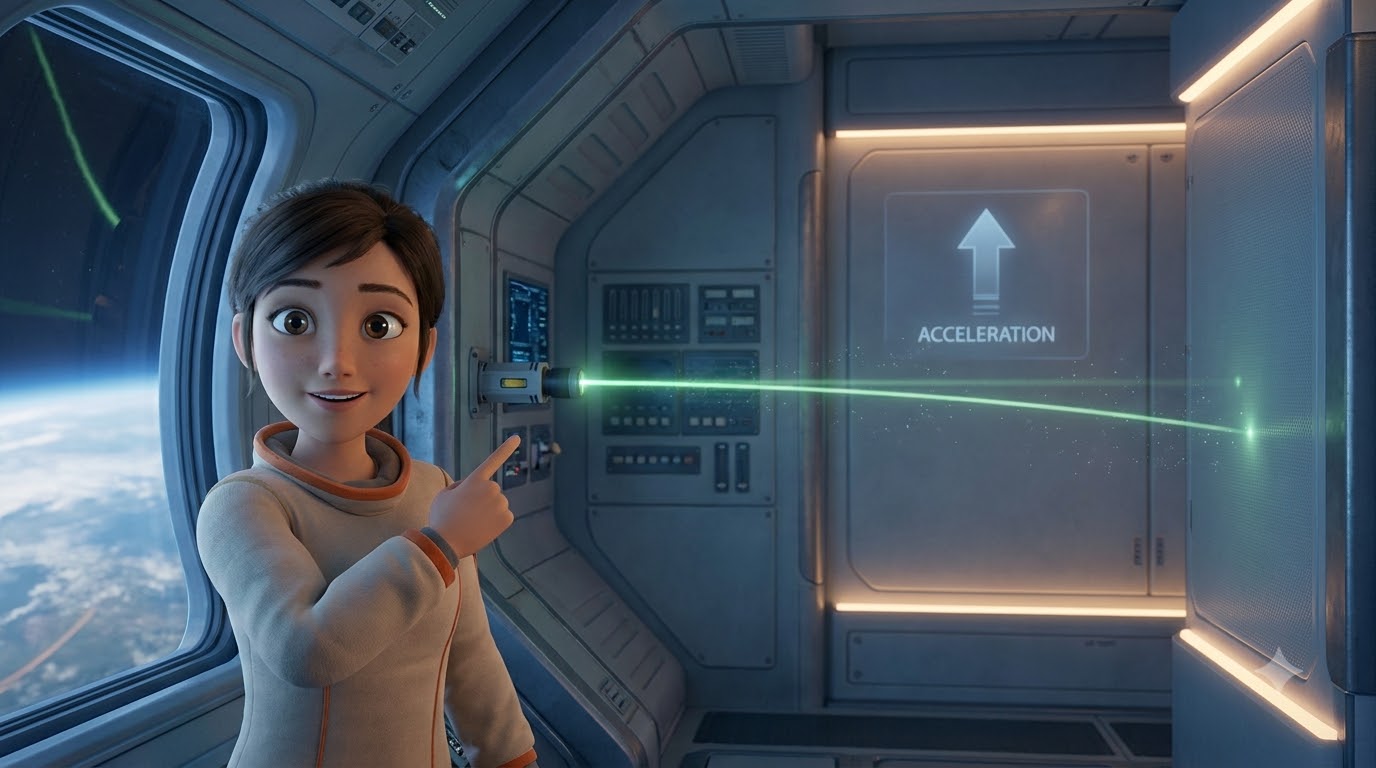
Therefore — by the Equivalence Principle — gravity must also bend light.
This was a genuinely shocking prediction. Light has no mass. In Newton’s gravity, massless things should not be affected by gravity at all. But Einstein’s logic was airtight: if the physics of acceleration is identical to the physics of gravity, and acceleration bends light, then gravity bends light too.
And this was confirmed. On 29 May 1919, during a total solar eclipse, the British astronomer Arthur Eddington photographed stars near the limb of the Sun. Their apparent positions were shifted compared to where they appeared at night — exactly as predicted by General Relativity. The Sun’s gravity was bending the light from stars behind it.
The news made headlines around the world and made Einstein an overnight celebrity.
✅ Established fact: Gravitational lensing — the bending of light by massive objects — has since been observed thousands of times. It is one of the most useful tools in modern astronomy, allowing us to study galaxies and dark matter that would otherwise be invisible.
Gravity Slows Down Time
Here is perhaps the most mind-bending implication of the Equivalence Principle.
Return to the accelerating rocket. Imagine a clock at the bottom of the rocket and a clock at the top. The bottom clock sends a light pulse upward to the top clock every second (by its own reckoning). But the rocket is accelerating. By the time each pulse travels from bottom to top, the top has accelerated away a little more. The pulses arrive at the top slightly less frequently than they were sent. The top clock therefore receives fewer signals per second — it sees the bottom clock ticking slow.
Now apply the Equivalence Principle: the bottom of the rocket is in a stronger effective gravitational field than the top. Therefore, in a gravitational field, clocks deeper in the field — closer to the source of gravity — run more slowly.
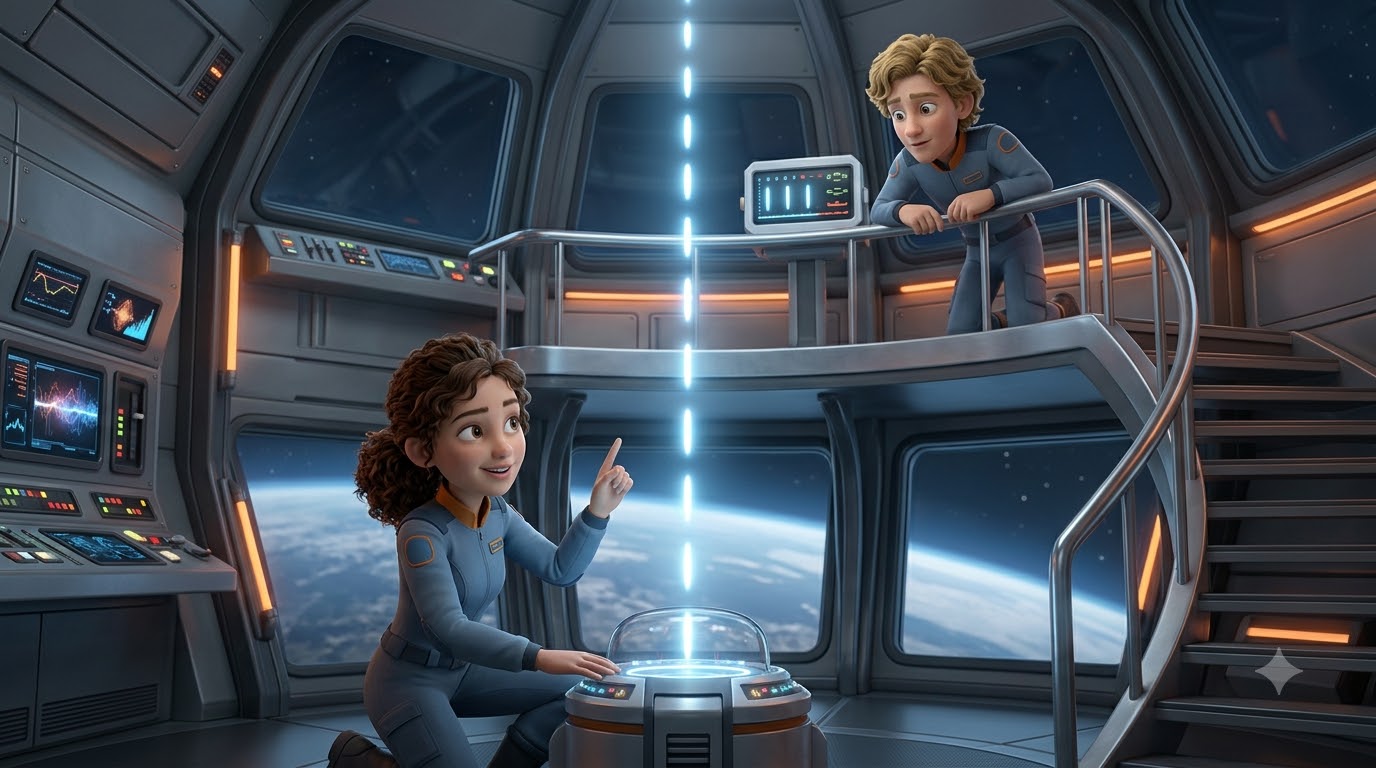
This is gravitational time dilation. It is not a quirk of clocks; it is real time itself running at different rates depending on where you are in a gravitational field.
- A clock at sea level ticks slightly slower than a clock on a mountain top.
- A clock near a black hole ticks dramatically slower than one far away in space.
- GPS satellites orbit high above Earth, where gravity is weaker. Their clocks tick faster than clocks on the ground. Engineers must correct for this (as well as for the slower ticking from their orbital speed) to keep GPS accurate. Without these corrections, GPS would drift by kilometres per day.
✅ Established fact: Gravitational time dilation has been measured directly with atomic clocks at different altitudes. It is a real, precisely quantified effect — not speculation.
The Geometry of Spacetime
The Equivalence Principle was Einstein’s starting point, but it pointed toward something even deeper: a geometric theory of gravity.
If gravity can be mimicked by acceleration, and if acceleration is just a change in your state of motion through spacetime, then perhaps gravity is not really a force at all. Perhaps it’s a feature of the geometry of spacetime itself.
This is exactly what General Relativity concludes. Massive objects warp the fabric of spacetime around them. Other objects — planets, light, even you — simply follow the straightest possible paths through that curved geometry. What we call the pull of gravity is actually the effect of curved spacetime geometry guiding everything along those paths.
The Equivalence Principle tells you locally what gravity feels like. General Relativity tells you globally what it actually is: the curvature of space and time caused by mass and energy.
A Quick Summary
| Concept | What it means |
|---|---|
| Free fall | Falling under gravity with no other force — feels like weightlessness |
| Equivalence Principle | Gravity and acceleration are locally indistinguishable |
| Gravitational lensing | Gravity bends light; confirmed by observations since 1919 |
| Gravitational time dilation | Clocks tick slower in stronger gravitational fields |
| Tidal effects | Tiny differences in gravity across a region; how gravity differs from uniform acceleration at large scales |
| General Relativity | The full theory: gravity as the curvature of spacetime, built on the Equivalence Principle |
Why This Matters
The Equivalence Principle might seem like an abstract philosophical point — a clever observation about elevators and rockets. But its consequences are everywhere:
- GPS and navigation depend on corrections for gravitational time dilation derived from this principle.
- Gravitational lensing is now a standard tool in cosmology, used to map dark matter and observe the earliest galaxies in the universe.
- Tests of the Equivalence Principle are among the most precise experiments ever conducted — any tiny violation would be a sign of new physics beyond General Relativity.
- Black holes and neutron stars, the most extreme gravitational environments known, are described entirely by a theory whose foundations rest on this principle.
Einstein’s “happiest thought” was not just a beautiful idea. It was a key that unlocked the geometry of the cosmos — and we are still using it today.
Further reading: For a non-mathematical treatment of General Relativity and the Equivalence Principle, see Gravity: An Introduction to Einstein’s General Relativity by James Hartle, or Einstein’s Gravity in a Nutshell by A. Zee. For the history and human story, try Einstein: His Life and Universe by Walter Isaacson.